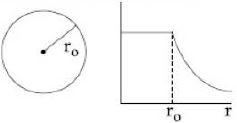
The give graph shown variation (with distance $r$ from centre) of
JEE MAIN 2019, Diffcult
Download our app for free and get started
The potential inside a uniformly charged shell is constant, while it decrease hyperbolically outside.
Download our app
and get started for free
Experience the future of education. Simply download our apps or reach out to us for more information. Let's shape the future of learning together!No signup needed.*
A parallel plate capacitor of capacitance $C$ has spacing $d$ between two plates having area $A$. The region between the plates is filled with $N$ dielectric layers, parallel to its plates, each with thickness $\delta=\frac{ d }{ N }$. The dielectric constant of the $m ^{\text {th }}$ layer is $K _{ m }= K \left(1+\frac{ m }{ N }\right)$. For a very large $N \left(>10^3\right)$, the capacitance $C$ is $\alpha\left(\frac{ K \varepsilon_0 A }{ d \;ln 2}\right)$. The value of $\alpha$ will be. . . . . . . .
Two opposite and equal charges $4 \times {10^{ - 8}}\,coulomb$ when placed $2 \times {10^{ - 2}}\,cm$ away, form a dipole. If this dipole is placed in an external electric field $4 \times {10^8}\,newton/coulomb$, the value of maximum torque and the work done in rotating it through $180^\circ $ will be
Positive and negative point charges of equal magnitude are kept at $\left(0,0, \frac{a}{2}\right)$ and $\left(0,0, \frac{-a}{2}\right)$, respectively. The work done by the electric field when another positive point charge is moved from $(-a, 0,0)$ to $(0, a, 0)$ is
At a distance $l$ from a uniformly charged long wire, a charged particle is thrown radially outward with a velocity $u$ in the direction perpendicular to the wire. When the particle reaches a distance $2 l$ from the wire, its speed is found to be $\sqrt{2} u$. The magnitude of the velocity, when it is a distance $4 l$ away from the wire is (ignore gravity)