The specific heat at constant pressure and at constant volume for an ideal gas are ${C_p}$ and ${C_v}$ and its adiabatic and isothermal elasticities are ${E_\varphi }$ and ${E_\theta }$ respectively. The ratio of ${E_\varphi }$ to ${E_\theta }$ is
Easy
Download our app for free and get started
(b) Ratio of adiabatic and isothermal elasticities
$\frac{{E\varphi }}{{E\theta }} = \frac{{\gamma \,P}}{P} = \gamma = \frac{{{C_p}}}{{{C_v}}}$

Download our appand get started for free
Experience the future of education. Simply download our apps or reach out to us for more information. Let's shape the future of learning together!No signup needed.*
Similar Questions
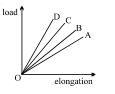
- 1View SolutionThe load versus strain graph for four wires of the same material is shown in the figure. The thickest wire is represented by the line
- 2A composite rod made up of two rods $AB$ and $BC$ are joined at $B$ . The rods are of equal length at room temperature and have equal masses. The coefficient of linear expansion a of $AB$ is more than that of $BC$. The composite rod is suspended horizontal by means of a thread at $B$. When the rod is heatedView Solution
- 3View SolutionModulus of rigidity of diamond is
- 4A composite rod made up of two rods $AB$ and $BC$ are joined at $B$ . The rods are of equal length at room temperature and have equal masses. The coefficient of linear expansion a of $AB$ is more than that of $BC$. The composite rod is suspended horizontal by means of a thread at $B$. When the rod is heatedView Solution
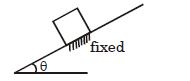
- 5View SolutionAssume that a block of very low shear modulus is fixed on an inclined plane as shown. Due to elastic forces it will deform. What will be the shape of the block ?
- 6The upper end of a wire of radius $4\, mm$ and length $100\, cm$ is clamped and its other end is twisted through an angle of $60^o$. Then angle of shear is .......... $^o$View Solution
- 7The following four wires of length $L$ and radius $r$ are made of the same material. Which of these will have the largest extension, when the same tension is applied?View Solution
- 8A uniformly tapering conical wire is made from a material of Young's modulus $Y$ and has a normal, unextended length $L.$ The radii, at the upper and lower ends of this conical wire, have values $R$ and $3R,$ respectively. The upper end of the wire is fixed to a rigid support and a mass $M$ is suspended from its lower end. The equilibrium extended length, of this wire, would equalView Solution
- 9Copper of fixed volume $V$ is drawn into wire of length $l$. When this wire is subjected to a constant force $F$, the extension produced in the wire is $\Delta l$. Which of the following graphs is a straight line?View Solution
- 10Steel and copper wires of same length are stretched by the same weight one after the other. Young's modulus of steel and copper are $2 \times {10^{11}}\,N/{m^2}$ and $1.2 \times {10^{11}}\,N/{m^2}$. The ratio of increase in lengthView Solution