Question
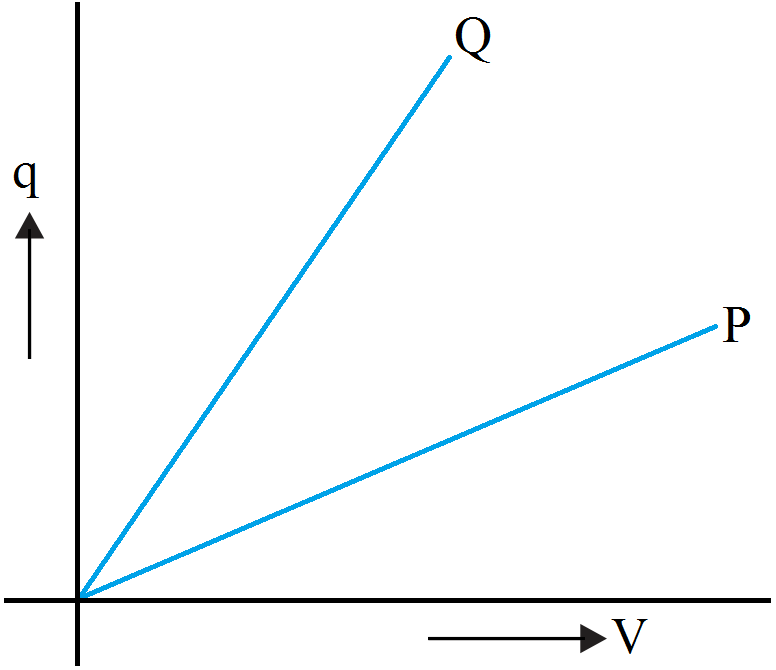
The given graph shows the variation of charge q versus potential difference V for two capacitors C1 and C2. The two capacitors have same plate separation but the plate area of C2 is double than that of C1. Which of the two graphs P and Q correspond to capacitors C1 and C2 and why?
Answer

Q represents C2 and P represents C1,
Reason: From the graph the slope $\frac{\text{q}}{\text{V}}$ Capacitance is greater for Q.
Also according to given conditions the capacitance $\frac{\varepsilon\text{A}}{\text{d}}$ is larger for the C2 because the area of its plates is large and d for the two capacitors is same. Hence, Q represents C2.

Need a full question paper?

Generate a complete, print-ready paper with questions like this in minutes — across 16+ boards, with answer keys.

Start Generating Free

Similar questions

Write any four points for photon picture of electromagnetic radiation.
State the principle of working of a cyclotron. Write two uses of this machine.
What physical quantity is the same for Χ-rays of wavelength 10-10m, red light of wavelength $6800\mathring{\text{A}}$ and radio waves of wavelength 500m?
Write the relation for the forces $\overrightarrow{F}$ acting on a charge carrier q moving with a velocity $\overrightarrow{V}$  through a magnetic field $\overrightarrow{B}$  in vector notation. Using this relation, deduce the conditions under which this force will be (1) maximum (2) minimum.
Depict the field-line pattern due to a bar magnet.
A soap film of thickness 0.0011mm appears dark when seen by the reflected light of wavelength 580nm. What is the index of refraction of the soap solution, if it is known to be between 1.2 and 1.5?
Answer the following question:
The angle subtended at the eye by an object is equal to the angle subtended at the eye by the virtual image produced by a magnifying glass. In what sense then does a magnifying glass provide angular magnification?
The average kinetic energy of molecules in a gas at temperature T is 1.5kT. Find the temperature at which the average kinetic energy of the molecules of hydrogen equals the binding energy of its atoms. Will hydrogen remain in molecular from at this temperature? Take k = 8.62 × 10⁻⁵eVK-1.
  1. An electrostatic field line is a continuous curve. That is, a field line cannot have sudden breaks. Why not?
  2. Explain why two field lines never cross each other at any point?
If a compressed spring is dissolved in acid, what happened to the elastic potential energy of the spring?