Questions · Page 1 of 2

2 Marks Questions

🎯

Test yourself on this topic

50 questions · timed · auto-graded

Question 12 Marks
Two charges 2 µC and –2 µC are placed at points A and B 6 cm apart.
  1. Identify an equipotential surface of the system.
  2. What is the direction of the electric field at every point on this surface?
Answer
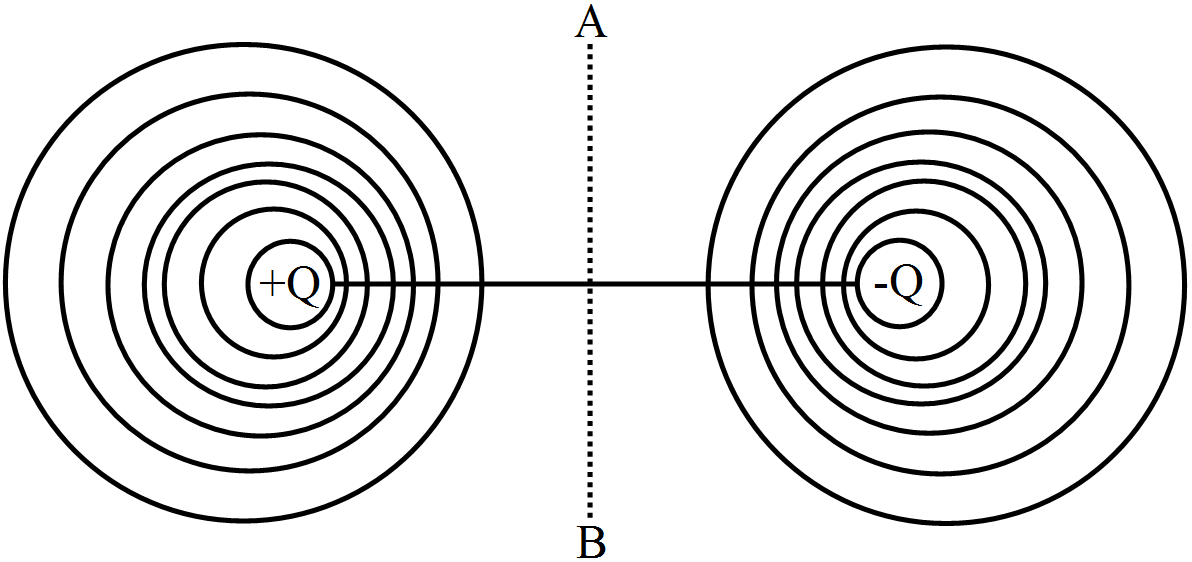
The situation is represented in the given figure.
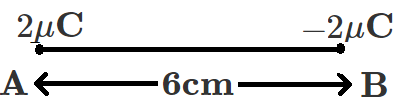
  1. An equipotential surface is the plane on which total potential is zero everywhere. This plane is normal to line AB. The plane is located at the mid-point of line AB because the magnitude of charges is the same.
  2. The direction of the electric field at every point on this surface is normal to the plane in the direction of AB.
View full question & answer
Question 22 Marks
In a Van de Graaff type generator a spherical metal shell is to be a 15 × 106V electrode. The dielectric strength of the gas surrounding the electrode is 5 × 107Vm–1. What is the minimum radius of the spherical shell required? (You will learn from this exercise why one cannot build an electrostatic generator using a very small shell which requires a small charge to acquire a high potential.)
Answer
Potential difference, V = 15 × 106V
otelectrtc strength of the surrounding gas $={5}\times{10}^{7}\frac{\text{V}}{\text{m}}$
Electric field intensity, E = Dielectric strength $= {5}\times {10}^{7}\frac{\text{V}}{\text{m}}$
Minimum radius of the spherical shell required for the purpose is given by,
$\text{r}=\frac{\text{V}}{\text{E}}$
$=\frac{15\times10^{6}}{5\times{10}^{7}}={0.3}\text{m}={30}\text{cm}$
Hence, the minimum radius of the spherical shell required is 30cm.
View full question & answer
Question 32 Marks
A small sphere of radius r1 and charge q1 is enclosed by a spherical shell of radius r2 and charge q2. Show that if q1 is positive, charge will necessarily flow from the sphere to the shell (when the two are connected by a wire) no matter what the charge q2 on the shell is.
Answer
According to Gauss's law, the electric field between a sphere and a shell is determined by the charge a, on a small sphere. Hence, the potential difference, V, between the sphere and the shell is independent of charge q2. For positive charge q1, potential difference Vis always positive.
View full question & answer
Question 42 Marks
Three capacitors each of capacitance 9 pF are connected in series.
  1. What is the total capacitance of the combination?
  2. What is the potential difference across each capacitor if the combination is connected to a 120 V supply?
Answer
Capacitance of each of the three capacitors, C = 9 pF

  1. Equivalent capacitance (C') of the combination of the capacitors is given by the relation,

$\frac{1}{\text{C}'}=\frac{1}{\text{C}}+\frac{1}{\text{C}}+\frac{1}{\text{C}}$

$=\frac{1}{9}+\frac{1}{9}+\frac{1}{9}=\frac{3}{9}=\frac{1}{3}$

$\therefore$ C' = 3µF

Therefore, total capacitance of the combination is 3µF.

  1. Supply voltage, V = 120 V

Potential difference (V) across each capacitor is equal to one-third of the supply voltage.

$\therefore\text{V}'=\frac{\text{V}}{3}=\frac{120}{3}=40\text{V}$

Therefore, the potential difference across each capacitor is 40 V.

View full question & answer
Question 52 Marks
Answer the following:
The discharging current in the atmosphere due to the small conductivity of air is known to be 1800A on an average over the globe. Why then does the atmosphere not discharge itself completely in due course and become electrically neutral? In other words, what keeps the atmosphere charged?
Answer
The occurrence of thunderstorms and lightning charges the atmosphere continuously. Hence, even with the presence of discharging current of 1800A, the atmosphere is not discharged completely. The two opposing currents are in equtllbnum and the atmosphere remains electrically neutral.
View full question & answer
Question 62 Marks
Answer the following:
A man fixes outside his house one evening a two metre high insulating slab carrying on its top a large aluminium sheet of area 1m2. Will he get an electric shock if he touches the metal sheet next morning?
Answer
Yes, the man will get an electric shock if he touches the metal slab next morning. The steady discharging current in the atmosphere charges up the alurnlniurn sheet. As a result, its voltage rises gradually. The raise in the voltage depends on the capacitance of the capacitor formed by the aluminium slab and the ground.
View full question & answer
Question 72 Marks
Describe schematically the equipotential surfaces corresponding to:
  1. a constant electric field in the z-direction.
  2. a field that uniformly increases in magnitude but remains in a constant (say, z) direction.
  3. a single positive charge at the origin, and.
  4. a uniform grid consisting of long equally spaced parallel charged wires in a plane.
Answer
  1. Equidistant planes parallel to the x-y plane are the equipotential surfaces.
  2. Planes parallel to the x-y plane are the equipotential surfaces with the exception that when the planes get closer, the field increases.
  3. Concentric spheres centered at the origin are equipotential surfaces.
  4. A periodically varying shape near the given grid is the equipotential surface. This shape qraduallv reaches the shape of planes parallel to the grid at a larger distance.
View full question & answer
Question 82 Marks
A slab of material of dielectric constant $K$ has the same area as the plates of a parallel-plate capacitor but has a thickness $(3 / 4) d$, where $d$ is the separation of the plates. How is the capacitance changed when the slab is inserted between the plates?
Answer
Let $E_0=V_0 / d$ be the electric field between the plates when there is no dielectric and the potential difference is $V_0$. If the dielectric is now inserted, the electric field in the dielectric will be $E=E_0 / K$. The potential difference will then be
$
\begin{array}{l}
V=E_0\left(\frac{1}{4} d\right)+\frac{E_0}{K}\left(\frac{3}{4} d\right) \\
=E_0 d\left(\frac{1}{4}+\frac{3}{4 K}\right)=V_0 \frac{K+3}{4 K}
\end{array}
$
The potential difference decreases by the factor $(K+3) / 4 K$ while the free charge $Q_0$ on the plates remains unchanged. The capacitance thus increases
$
C=\frac{Q_0}{V}=\frac{4 K}{K+3} \frac{Q_0}{V_0}=\frac{4 K}{K+3} C_0
$
View full question & answer
Question 92 Marks
A molecule of a substance has a permanent electric dipole moment of magnitude $10^{-29} C m$. A mole of this substance is polarised (at low temperature) by applying a strong electrostatic field of magnitude $10^6 V m ^{-1}$. The direction of the field is suddenly changed by an angle of $60^{\circ}$. Estimate the heat released by the substance in aligning its dipoles along the new direction of the field. For simplicity, assume $100 \%$ polarisation of the sample.
Answer
Here, dipole moment of each molecules $=10^{-29} C m$ As 1 mole of the substance contains $6 \times 10^{23}$ molecules, total dipole moment of all the molecules, $p=6 \times 10^{23} \times 10^{-29} C m$
$
=6 \times 10^{-6} C m
$
Initial potential energy, $U_i=-p E \cos \theta=-6 \times 10^{-6} \times 10^6 \cos 0^{\circ}=-6 J$ Final potential energy (when $\theta=60^{\circ}$ ), $U_f=-6 \times 10^{-6} \times 10^6 \cos 60^{\circ}=-3 J$ Change in potential energy $=-3 J -(-6 J )=3 J$
So, there is loss in potential energy. This must be the energy released by the substance in the form of heat in aligning its dipoles.
View full question & answer
Question 102 Marks
(a) Calculate the potential at a point $P$ due to a charge of $4 \times 10^{-7} C$ located $9 cm$ away.
(b) Hence obtain the work done in bringing a charge of $2 \times 10^{-9} C$ from infinity to the point P. Does the answer depend on the path along which the charge is brought?
Answer
$
\begin{aligned}
(a) V & =\frac{1}{4 \pi \varepsilon_0} \frac{Q}{r}=9 \times 10^9 Nm ^2 C ^{-2} \times \frac{4 \times 10^{-7} C }{0.09 m } \\
& =4 \times 10^4 V
\end{aligned}
$
$
\begin{aligned}
(b) W & =q V=2 \times 10^{-9} C \times 4 \times 10^4 V \\
& =8 \times 10^{-5} J
\end{aligned}
$
No, work done will be path independent. Any arbitrary infinitesimal path can be resolved into two perpendicular displacements: One along $r$ and another perpendicular to $r$. The work done corresponding to the later will be zero.
View full question & answer
Question 112 Marks
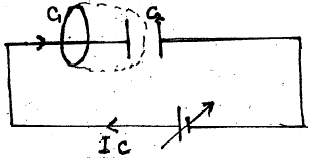
A capacitor of capacitance 'C' is being charged by connecting it across a dc source along with an ammeter.Will the ammeter show a momentary deflection during the process of charging? If so, how would you explain this momentary deflection and the resulting continuity of current in the circuit? Write the expression for the current inside the capacitor.
Answer
Yes, ammeter will show a momentary deflection. The momentary deflection is due to the flow of electrons in the circuit during the charging process. During the charging process the electric field between the capacitor plates is changing and hence a displacement current flows in the gap. Hence we can say that there is a continuity of current in the circuit. 
Expression $\text{I}_{d} = \in_{0}\frac{\text{d}\phi}{\text{dt}}.$
View full question & answer
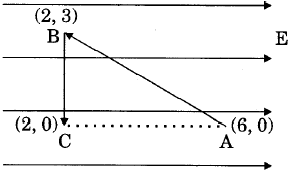
Question 122 Marks
A test charge 'q' is moved without acceleration from A to C along the path from A to B and then from B to C in electric field E as shown in the figure. (i) Calculate the potential difference between A and C. (ii) At which point (of the two) is the electric potentialmore and why?

Answer
Since E = - d V/dr
E = (VC - VA )/4
Therefore, V- VC = - 4 E
At Point C, potential is more
Electric field is in the direction in which the potential decreases.
View full question & answer
Question 132 Marks
An electric dipole is held in a uniform electric field:
  1. Show that the net force acting on it is zero.
  2. The dipole is aligned parallel to the field. Find the work done in rotating it through the angle of 180o.
Answer
  1. $\overrightarrow{\text{F}_{1}} = + \text{q} \overrightarrow{\text{E}}\text{ and }\overrightarrow{\text{F}_{2}} = - \text{q}\overrightarrow{\text{E}}$

$\overrightarrow{\text{F}_{net}} = \overrightarrow{\text{F}_{1}} + \overrightarrow{\text{F}_{2}}$

$\therefore\text{F}_{net} = 0 $

Alternate Answer

$\therefore\text{F}_{net} = 0 $

  1. W = EP (cos θ1 – cos θ2)

W = 2EP.

View full question & answer
Question 142 Marks
A parallel plate capacitor is being charged by a time varying current. Explain briefly how Ampere's circuital law is generalized to incorporate the effect due to the displacement current. 
Answer

According to Ampere's circuital law, $\oint\overline{\text{B}}.\overline{\text{dl}} = \mu_{o}\text{I}_{en}$

For C$\oint\overline{\text{B}}.\overline{\text{dl}} = \mu_{o}\text{I}_{en}$

For C$\oint\overline{\text{B}}.\overline{\text{dl}} = 0 $

There is an inconsistency in Ampere's circuital law.To explain this displacement current was incorporated.

Using Ampere's law, we find different values of B for the two loops.

Hence displacement current was introduced.

View full question & answer
Question 152 Marks
Net capacitance of three identical capacitors in series is $1\mu\text{F}.$ What will be their net capacitance if connected in parallel?
Find the ratio of energy stored in the two configurations if they are both connected to the same source.
Answer
$\frac{1}{\text{C}_\text{s}}=\frac{1}{\text{c}}+\frac{1}{\text{c}}+\frac{1}{\text{c}}$

$\frac{1}{\text{C}_{s}} = \frac{3}{\text{C}}$

$\text{C}_{\text{s}} = \frac{\text{C} }{ 3 }$

$1= \frac{\text{C}} {3}$

$\therefore\text{C} = 3 \mu\text{F}$

$\text{C}_{p} = \text{C}_{1} + \text{C}_{2} + \text{C}_{3} = 9 \mu \text{F}$

$\frac{\text{E}_{S}}{\text{E}_{P}} = \frac{\frac{1}{2}\text{C}_{s}\text{V}^{2}}{\frac{1}{2}\text{C}_{P}\text{V}^{2}}$

$ = \frac{1}{9}.$

View full question & answer
Question 162 Marks
A spherical conducting shell of inner radius r1 and outer radius r2 has a charge ‘Q’. A charge ‘q’ is placed at the centre of the shell.
  1. What is the surface charge density on the (i) inner surface, (ii) outer surface of the shell?
  2. Write the expression for the electric field at a point x > r2 from the centre of the shell.
Answer
  1.  
    1. Surface charge density on inner surface

$\sigma = \frac{-\text{q}}{4\pi\text{r}_{1}^{2}}$

  1. Surface charge density on outer surface

$\sigma = \frac{\text{Q} + \text{q}}{4\pi\text{r}_{2}^{2}}$

Electric field at a (an outside) point distant x from centre of the shell

$\text{E} = \frac{\text{Q} + \text{q}}{4\pi\varepsilon_{0}\text{x}^{2}}.$

View full question & answer
Question 172 Marks
Draw 3 equipotential surfaces corresponding to a field that uniformly increases in magnitude but remains constant along Z-direction. How are these surfaces different from that of a constant electric field along Z-direction?
Answer
For constant electric field.
For increasing electric field.

For constant electric field, equipotential surfaces are equidistant for same potential difference between these surfaces. For increasing field, separation between these surfaces decreases, in the direction of increasing field, for the same potential difference between them.
View full question & answer
Question 182 Marks
Two point charges, q1 = 10 × 10–8 C and q2 = – 2 × 10⁻⁸ C are separated by a distance of 60 cm in air.
  1. Find at what distance from the 1st charge, q1 would the electric potential be zero.
  2. Also calculate the electrostatic potential energy of the system.
Answer
$\frac{\text{Kq}_{1}}{\text{x}} + \frac{\text{Kq}_{2}}{(\text{r} - \text{x})} =0\text{ if }(\text{x} < r)$

$\text{ or } \frac{\text{Kq}_{1}}{\text{x}} + \frac{\text{Kq}_{2}}{\text{x} - \text{r}} = 0\text{ if }(\text{x} > \text{r})$

which gives, x = 50 cm (from q1 = 10 × 10-8 C)

or x = 75cm

$\text{u} =\frac{\text{kq}_{1}\text{q}_{2}}{\text{r}}$

$\text{u} = -3\times10^{-5}\text{J}.$

View full question & answer
Question 192 Marks
Two point charges $4\mu\text{C}$ and $-2 \mu\text{C}$  are separated by a distance of 1 m in air. Calculate at what point on the line joining the two charges is the electric potential zero.
Answer
When point is taken on the line between the two charges.

$\text{V} = \text{K}\bigg[\frac{\text{q}_{1}}{\text{x}} +\frac{\text{q}_{2}}{\big(1 - \text{x}\big)}\bigg] = 0$

Substitution & calculation,

$\text{x} = 1/3\text{m}\big(\text{from} -2\mu\text{c}\big)$

or 0.33m

Alternate Answer

If point is taken on the extended line, beyond $ -2 \mu\text{c}.$

$\text{V} =\text{K}\bigg[\frac{\text{q}_{1}}{\text{y}} +\frac{ \text{q}_{2}}{\big(1+\text{y}\big)}\bigg] = 0$

Calculation,

$\text{y} = 1\text{m}\big(\text{from} - 2 \mu\text{C}\big)$.

View full question & answer
Question 202 Marks
A parallel plate capacitor with air between the plates has a capacitance of 8 pF. The separation between the plates is now reduced by half and the space between them is filled with a medium of dielectric constant 5. Calculate the value 
of capacitance of the capacitor in the second case.
Answer
$\text{c} =\frac{\text{A}\varepsilon_{\circ}\varepsilon_{r}}{\text{d}}$ or $\frac{\text{k}\varepsilon_{\circ}\text{A}}{\text{d}}$

$\text{c} = 5\times\frac{\varepsilon_{\circ}\text{A}}{\text{d}/2}$

$\text{c} = 10 \bigg(\frac{\text{A}\varepsilon_{\circ}}{\text{d}}\bigg) = 10 \times8 = 80\text{pf}$.

View full question & answer
Question 212 Marks
Two capacitors of capacitance 6 μF an 12 μF are connected in series with a battery. The voltage across the 6 capacitor is 2 V. Compute the total battery voltage.
Answer
$\text{C}_{1}\text{V}_{1} = \text{C}_{2}\text{V}_{2}$

Calculation of $\text{V}_{2} - \text{IV}$

$\text{V} = \text{V}_{1} + \text{V}_{2} = 3\text{V}$

Alternate Answer

Calculation of equivalent capacitance $ = 4\mu\text{f}$

$4\times\text{Battery Voltage = 6\times2}$

$\therefore \text{Battery Voltage} = 3 \text{V}$.

View full question & answer
Question 222 Marks
A point charge ‘q’ is placed at O as shown in the figure. 

Is VP — VQ positive or negative when (i) q > 0, (ii) q < 0? Justify your answer.

Answer
  1. q > 0 $\text{V} = \frac{\text{kq}}{\text{r}}$

Since $\text{V} \propto \frac{1}{\text{r}} , \text{Vp}>\text{V}_\text{Q}$

$\therefore \text{Vp} - \text{V}_\text{Q}\ \text{is } + \text{ve}$

  1. q < 0   , Vp < VQ

$\therefore \text{Vp} - \text{V}_\text{Q}\ \text{ is} - \text{ve}$.

View full question & answer
Question 232 Marks
An electric dipole of length I cm, which placed with its axis making an angle of $60^{\circ}$with uniform electric field, experiences a torque of $6\sqrt{3}$ Nm. Calculate the potential energy of the dipole if it has charge $\pm$ 2 nC.
Answer
$\tau = \text{pE}\sin\theta$

$6\sqrt{3} = \text{pE}\sin60^{0} = \text{pE}\frac{\sqrt{3}}{2}$

$\Rightarrow\text{pE} = 12$

Potential energy

$ \text{U} = - \text{pE}\cos\theta$

$ = - 12 \text{ x }\cos60^{0} = -6\text{J}.$

View full question & answer
Question 242 Marks
An electric dipole of length 2 cm, when placed with its axis making an angle of $60^\circ$with a uniform electric field, experiences a torque of $8\sqrt{3}$ Nm. Calculate the potential energy of the dipole, if it has a charge of $\pm4\text{nC}.$
Answer
$\tau = \text{pE}\sin\theta$

$8\sqrt{3} = \text{pE}\sin60^{0} = \text{pE}\frac{\sqrt{3}}{2}$

$\Rightarrow\text{pE} = 16 $

Potential energy,

$\text{U} = - \text{pE}\cos\theta$

$= - 16 \text{ x }\cos60^{0} = -8\text{J}.$

View full question & answer
Question 252 Marks
When an ideal capacitor is charged by a dc battery, no current flows. However, when an ac source is used, the current flows continuously. How does one explain this, based on the concept of displacement current?
Answer
When an ideal capacitor is charged by dc battery, charge flows (momentarily) till the capacitor gets fully charged. When an ac source is connected then conduction current $\text{i}_{c} =\frac{\text{dq}}{\text{dt}}$ keep on flowing in the connecting wires.
Due to changing current, charge deposited on the plates of the capacitor changes with time.This causes change in electric field between the plates of the capacitor which causes the electric flux to change and gives rise to a displacement current in the region between the plates of the capacitor. Displacement current id is given by i$ = \in_{0}\frac{\text{dq}_{E}}{\text{dt}}$ and is equal to the conduction current at all instants.
View full question & answer
Question 262 Marks
Draw a plot showing the variation of (i) electric field (E) and (ii) electric potential (V) with distance r due to a point charge Q.
View full question & answer
Question 272 Marks
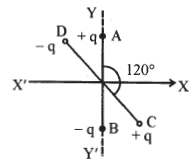
Two small identical electrical dipoles AB and CD, each of dipole moment 'p' are kept at an angle of 120o as shown in the figure. What is the resultant dipole moment of this combination? If this system is subjected to electric field ($\overrightarrow{\text{E}}$) directed along +X direction, what will be the magnitude and direction of the torque acting on this?

Answer
Resultant dipole moment= p.
The magnitude of torque is pE sin 30° = $\frac{\text{pF}}{2}$
The direction of torque is clockwise when viewed from above.
(or $\overrightarrow{\tau}$is perpendicular to both $\overrightarrow{\text{p}}$ and $\overrightarrow{\text{E}}$).
View full question & answer
Question 282 Marks
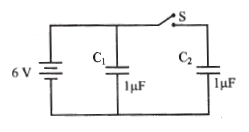
Figure shows two identical capacitors, C1 and C2, each of 1 μF capacitance connected to a battery of 6 V. Initially switch 'S' is closed. After sometime 'S' is left open and dielectric slabs of dielectric constant K = 3 are inserted to fill completely the space between the plates of the two capacitors. How will the (i) charge and (ii) potential difference between the plates of the capacitors be affected after the slabs are inserted?

Answer
P.D. across C1 = 6V

Final charge on C1 = 18$\mu$C

P.D. across C2 = 2V

Final charge on C2 = 6$\mu$C

Alternate Answer

Q = CV
C' = KC

Across C1,V remains same but charge increases.

Across C2, charge Q remains same but p.d. decreases.

View full question & answer
Question 292 Marks
Two uniformly large parallel thin plates having charge densities +σ and –σ are kept in the X-Z plane at a distance 'd' apart. Sketch an equipotential surface due to electric field between the plates. If a particle of mass m and charge '-q' remains stationary between the plates, what is the magnitude and direction of this field?
Answer
Depiction of equipotential surtace

(Parallel to the X - Z plane)

qE = mg

$\Rightarrow\text{E} = \frac{\text{mg}}{\text{q}}: $ direction vertically downwards.

View full question & answer
Question 302 Marks
  1. Can two equipotential surfaces intersect each other? Give reasons.
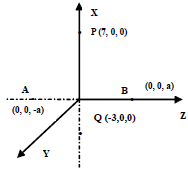
  2. Two charges – q and +q are located at points A (0, 0, –a) and B (0, 0, +a) respectively. How much work is done in moving a test charge from point P (7, 0, 0) to Q (-3, 0, 0)?
Answer
  1. No

Reason: At the point of intersection, there will then be two values of electric potential which is not possible.

Alternate Answer

Electric field at the same point will point in two different directions which is not possible.

  1.  


Test charge is moved along the equatorial line of the dipole. Hence work done in moving this charge is zero.

View full question & answer
Question 312 Marks
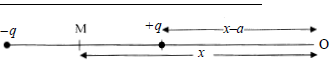
Derive an expression for the electric potential at any point along the axial line of an electric dipole?
Answer
 

Potential at O due to the dipole

$\text{V} = \text{V}_{1} + \text{V}_{2}$

 $\therefore\text{V} = \frac{ \text{q}}{4\pi\varepsilon_\circ}\bigg[\frac{1}{\text({x} - a )}- \frac{1}{(\text{x} + a )}\bigg]$

$ = \frac{1}{4\pi\varepsilon_\circ} \frac{\text{q.2a}}{\big(\text{x}^{2} - \text{a}^{2}\big)}$

 $= \frac{ 1}{ 4\pi\varepsilon_\circ} \frac{p}{\big(x^2 - a^2\big)}.$

View full question & answer
Question 322 Marks
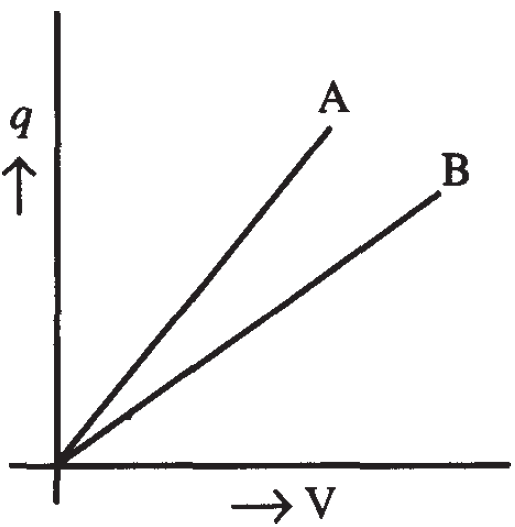
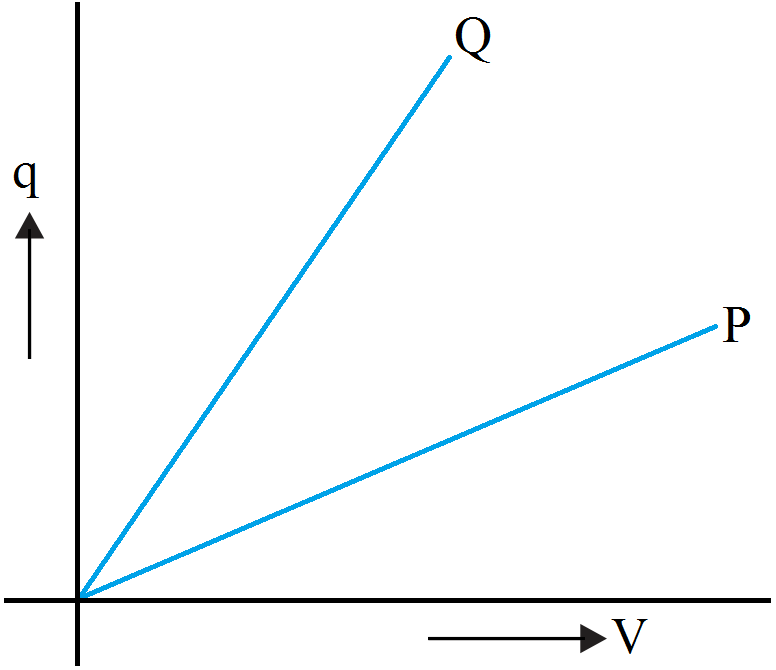
The given graph shows the variation of charge q versus potential difference V for two capacitors C1 and C2. The two capacitors have same plate separation, but the plate area of C2 is double than that of C1. Which of the lines in the graph correspond to C1 and C2 and why?

Answer
Line A represents C2

Line B represents C1

$\because \text{C}=\frac{\text{A}\varepsilon_{\circ}}{\text{d}}$

$\therefore \text{C}_{2}= 2\text{C}_{1}$

Also, slope of line   $\frac{\text{q}}{\text{V}}=\text{C}$

Line A, of greater slope, corresponds to C2  while line B corresponds to C1.

View full question & answer
Question 332 Marks
The electric field and electric potential at any point due to a point charge kept in air is $20 NC^{-1}$ and $10 NC^{-1}$ respectively. Compute the magnitude of this charge.
Answer
$E=\frac{1}{4\pi\varepsilon_\circ}$ $\frac{q}{r^{2}}$..................................... (i)

$ V=\frac{1}{4\pi\varepsilon_\circ}$ $\frac{q}{r}$........................................(ii)

$\therefore V=\frac{V^{2}}{E}4\pi\varepsilon_{\circ }$

$=\frac{10\times10}{20}\times\frac{1}{9\times10^{9}}C$

$=\frac{5}{9}\times10^{^-9}C$ 

Alternate Answer 

Dividing equation (ii) by (i)

$r=\frac{V}{E}=\frac{10}{20}=0.5m$

Substituting the value of r in (i) or (ii) and solving

$q=\frac{5}{9}\times10^{-9}C$

View full question & answer
Question 342 Marks
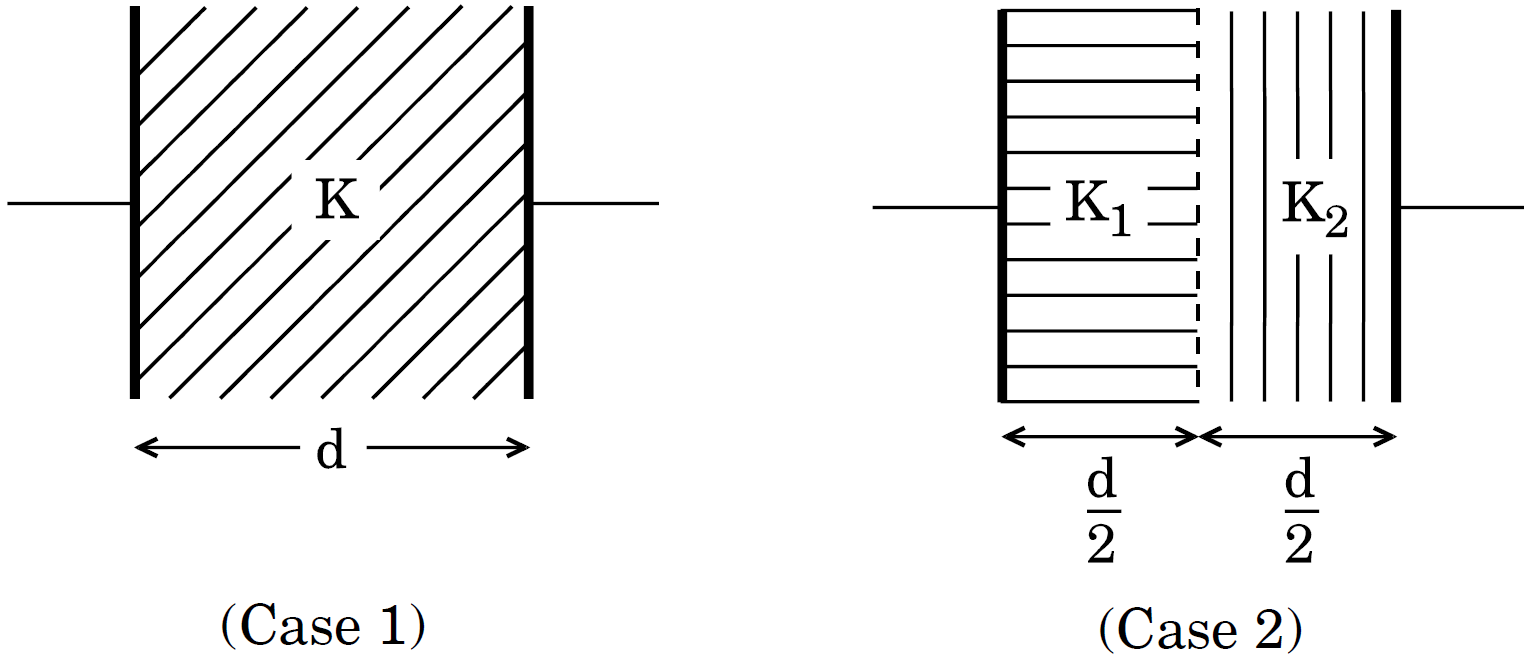
The space between the plates of a parallel plate capacitor is completely filled in two ways. In the first case, it is filled with a slab of dielectric constant K. In the second case, it is filled with two slabs of equal thickness and dielectric constants K1 and K2 respectively as shown in the figure. The capacitance of the capacitor is same in the two cases. Obtain the relationship between K, K1 and K2.

Answer
$\text{C}_1=\frac{\text{K}\varepsilon_0\text{A}}{\text{d}}$

C= parallel combination of two capacitors,

$=\frac{\text{K}_1\varepsilon_0\big(\frac{\text{A}}{2}\big)}{\text{d}}+\frac{\text{K}_2\varepsilon_0\big(\frac{\text{A}}{2}\big)}{\text{d}}$

$\frac{\varepsilon_0\text{A}}{2\text{d}}\big(\text{K}_1+\text{K}_2\big)$

$\because\text{C}_1=\text{C}_2$

$\Rightarrow\text{K}=\frac{\text{K}_1+\text{K}_2}{2}$

View full question & answer
Question 352 Marks
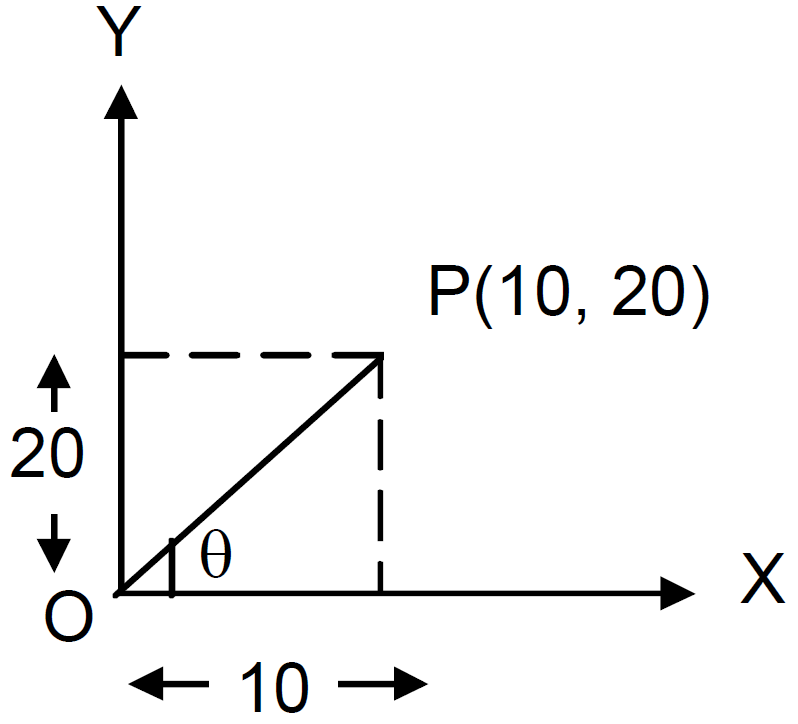
An electric field $\vec{\text{E}}=\vec{\text{i}}\text{Ax}$ exists in the space, where A= 10Vm-2. Take the potential at (10m, 20m) to be zero. Find the potential at the origin.
Answer

$\text{E}=\vec{\text{i}}\times\text{Ax}=100\vec{\text{i}}$

$\int\limits_\text{v}^0\text{dv}=-\int\limits\text{E}\times\text{d}\ell$

$\text{V}=-\int\limits_0^{10}10\text{x}\times\text{dx}$

$=-\int\limits^{10}_0\frac{1}{2}\times10\times\text{x}^2$

$0-\text{V}=-\Big[\frac{1}{2}\times1000\Big]$

$=-500$

$\Rightarrow\text{V}=500\text{ Volts}$

View full question & answer
Question 362 Marks
Two conducting spheres of radii R1 and R2 are kept widely separated from each other. What are their individual capacitances? If the spheres are connected by a metal wire, what will be the capacitance of the combination? Think in terms of series-parallel connections.
Answer
$\text{C}=\frac{\text{q}}{\text{V}},$ Now $\text{V}=\frac{\text{kq}}{\text{R}}$

So, $\text{C}_1=\frac{\text{q}}{\Big(\frac{\text{Kq}}{\text{R}_1}\Big)}=\frac{\text{R}_1}{\text{K}}=4\pi\in_0\text{R}_1$

Similarly, $\text{c}_2=4\pi\in_0\text{R}_2$

The combination is necessarily parallel.

Hence $\text{C}_{\text{eq}}=4\pi\in_0\text{R}_1+4\pi\in_0\text{R}_2=4\pi\in_0(\text{R}_1+\text{R}_2)$

View full question & answer
Question 372 Marks
Define dielectric constant of a medium. What is the value of dielectric constant for a metal?
Answer
The dielectric constant of a medium is defined on the ratio of permittivity of medium to the permittivity of free space. The dielectric constant is also called the relative permittivity of medium,

$\varepsilon_{\text{r}}=\text{K}=\frac{\varepsilon}{\varepsilon_{0}}$

The value of dielectric constant for a metal is infinity i.e., $\text{K}_{\text{metal}}=\infty$

View full question & answer
Question 382 Marks
How does the energy stored in a capacitor change if the plates of a charged capacitor are moved farther, the battery remaining connected?
Answer
The capacitance of capacitor decreases on moving its plates farther. As the battery remains connected, the potential difference remains constant. Hence, energy stored $\text{U}=\frac{1}{2}\text{CV}^2,$ decreases.
View full question & answer
Question 392 Marks
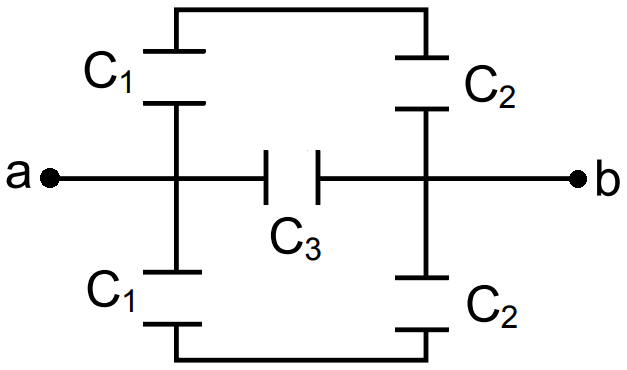
Find the equivalent capacitance of the syatem shown in figure between the points a and b.

Answer

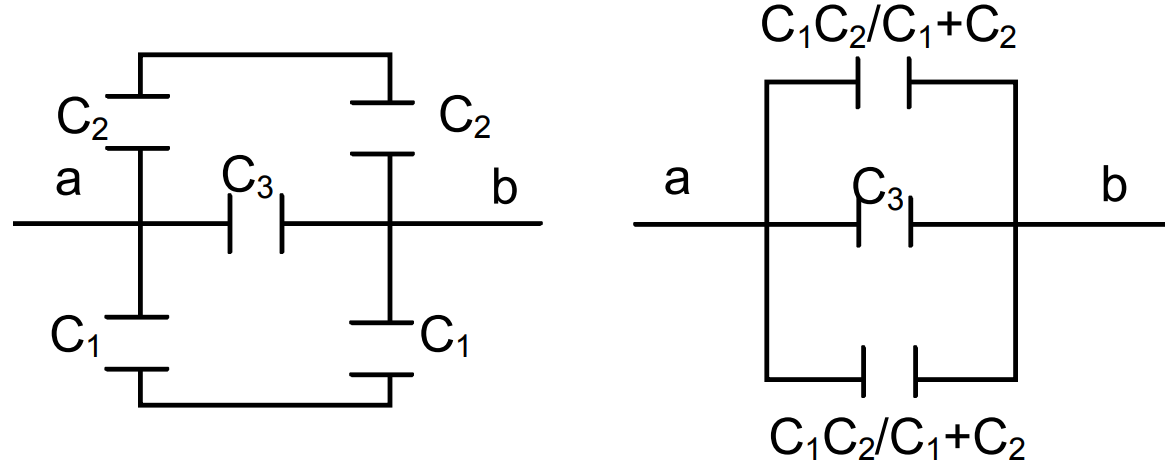
Ceq between a & b

$=\frac{\text{C}_1\text{C}_2}{\text{C}_1+\text{C}_2}+\text{C}_3+\frac{\text{C}_1\text{C}_2}{\text{C}_1+\text{C}_2}$

$=\text{C}_3+\frac{2\text{C}_1\text{C}_2}{\text{C}_1+\text{C}_2}$ $(\therefore$ The three are parallel$)$

View full question & answer
Question 402 Marks
12J of work has to be done against an existing electric field to take a charge of 0.01C from A to B. How much is the potential difference VB - VA?
Answer
Now, VB - VA = Potential diff = ?

Charge = 0.01C

Work done = 12J

Now, Work done = Pot. Diff × Charge

$\Rightarrow\text{W} =\big(\text{V}_\text{B} -\text{V}_\text{A}\big)\times\text{q}$

$\Rightarrow\text{Pot. Diff}=\frac{12}{0.01}$

$=1200\text{ Volt}$

View full question & answer
Question 412 Marks
Express dielectric constant of a medium in terms of capacitance. What is its SI unit?
Answer
The dielectric constant of a medium is defined as the ratio of capacitance of capacitor when filled with a medium to capacitance of same capacitor when medium is removed.

$\text{i.e}.,\text{K}=\frac{\text{C}_{\text{medium}}}{\text{C}_{0}}$

It has no unit.

View full question & answer
Question 422 Marks
When a capacitor is charged by a battery; is the energy stored in the capacitor same as energy supplied by the battery?
Answer
No, Energy stored in the capacitor $=\frac{1}{2}\text{CV}^2=\frac{1}{2}\text{qV}$ while energy supplied by battery = qV.
The balance of energy is dissipated as heat during charging.
View full question & answer
Question 432 Marks
A 100pF capacitor is charged to a potential difference of 24V. It is connected to an uncharged capacitor of capacitance 20pF. What will be the new potential difference across the 100pF capacitor?
Answer
Given that

C = 100PF = 100 × 10-12F

Ceq = 20PF = 20 × 10-12F

V = 24v

q = 24 × 100 × 10-12 = 24 × 10-10

q2 = ?

Let q1 = The new charge 100PF

V1 = The Voltage.

Let the new potential is V1

After the flow of charge, potential is same in the two capacitor

$\text{V}_1=\frac{\text{q}_2}{\text{C}_2}=\frac{\text{q}_1}{\text{C}_1}$

$=\frac{\text{q}-\text{q}_1}{\text{C}_2}=\frac{\text{q}_1}{\text{C}_1}$

$=\frac{24\times10^{-10}-\text{q}_1}{24\times10^{-12}}=\frac{\text{q}_1}{100\times10^{-12}}$

$=24\times10^{-10}-\text{q}_1=\frac{\text{q}_1}{5}$

$=6\text{q}_1=120\times10^{-10}$

$=\text{q}_1=\frac{120}{6}\times10^{-10}=20\times10^{-10}$

$\therefore\text{V}_1=\frac{\text{q}_1}{\text{C}_1}=\frac{20\times10^{-10}}{100\times10^{-12}}=20\text{v}$

View full question & answer
Question 442 Marks
How does the energy stored in a capacitor change if after disconnecting the battery, the plates of a charged capacitor are moved farther?
Answer
Capacitance $\text{C}\propto\frac{1}{\text{d}},$ when plates of a capacitor are moved farther, the capacitance decreases. After disconnecting the battery, the charge on capacitor $\text{U}\Big(=\frac{\text{q}^2}{2\text{C}}\Big ),$ increases.
View full question & answer
Question 452 Marks
The given graph shows the variation of charge q versus potential difference V for two capacitors C1 and C2. The two capacitors have same plate separation but the plate area of C2 is double than that of C1. Which of the two graphs P and Q correspond to capacitors C1 and C2 and why?

Answer
Q represents C2 and P represents C1,
Reason: From the graph the slope $\frac{\text{q}}{\text{V}}$ Capacitance is greater for Q.
Also according to given conditions the capacitance $\frac{\varepsilon\text{A}}{\text{d}}$ is larger for the C2 because the area of its plates is large and d for the two capacitors is same. Hence, Q represents C2.
View full question & answer
Question 462 Marks
Show that the equipotential surfaces are closed together in the regions of strong field and far apart in the regions of weak field. Draw equipotential surfaces for an electric dipole.
Answer
Equipotential surfaces are closer together in the regions of strong field and farther apart in the regions of weak field.

$\text{E}=-\frac{\text{dV}}{\text{dr}}$

E = negative potential gradient,

For same change in dV, $\text{E}=-\frac{\text{dV}}{\text{dr}}$ where ‘dr’ represents the distance between equipotential surfaces.

View full question & answer
Question 472 Marks
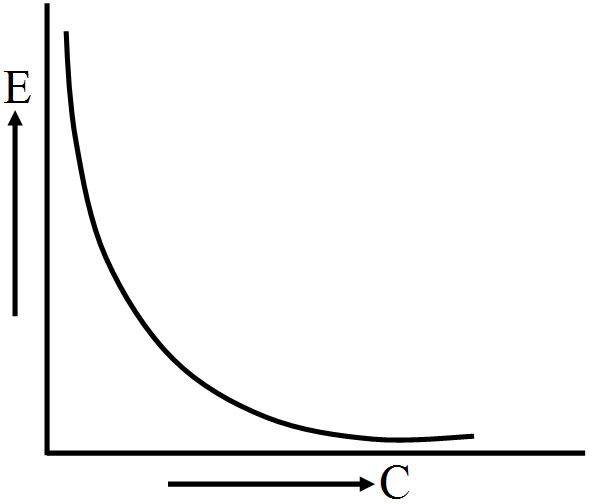
The graph shown here shows the variation of total energy (E) stored in a capacitor against the value of the capacitance (C) itself. Which of the two: the charge on capacitor or the potential used to charge it, is kept constant for this graph?

Answer
The given graph represents, $\text{E}\propto\frac{1}{\text{C}}$
This is satisfied by the expression, $\text{E}=\frac{\text{q}^2}{2\text{C}}\propto\frac{1}{\text{C}}$ for constant q.
That is, the charge (q) is kept constant.
View full question & answer
Question 482 Marks
A very thin plate of metal is placed exactly in the middle of the two plates of a parallel plate capacitor. What will be the effect on the capacitance of the system?
Answer
For a metal $\text{K}=\infty$ and so when t << d, the capacitance,

$\text{C}=\frac{\varepsilon_0\text{A}}{\text{d}-\text{t}\Big(1-\frac{1}{\text{K}}\Big)}=\frac{\varepsilon_0\text{A}}{\text{d}-\text{t}\Big(1-\frac{1}{\infty}\Big)}=\frac{\varepsilon_0\text{A}}{\text{d}-\text{t}}$

$\text{As}\ \text{t}<<\text{dC}=\frac{\varepsilon_0\text{A}}{\text{d}},$ i.e., capacitance will remain unchanged.

View full question & answer
Question 492 Marks
In some old texts it is mentioned that $4\pi$ lines of force originate from each unit positive charge. Comment on the statement in view of the fact that $4\pi$ is not an integer.
Answer
$4\pi$ is the total solid angle. "$4\pi$ lines of force" is just a way of stating that the field lines extend uniformly in all directions away from the charge.
View full question & answer
Question 502 Marks
An electron and a proton are brought nearer; how does the potential energy of system change?
Answer
There is attractive force between an electron and a proton, therefore when they come nearer, the work is done by the system itself and so the potential energy of system decreases.
View full question & answer
2 Marks Questions - Physics STD 12 Science Questions - Vidyadip