Question
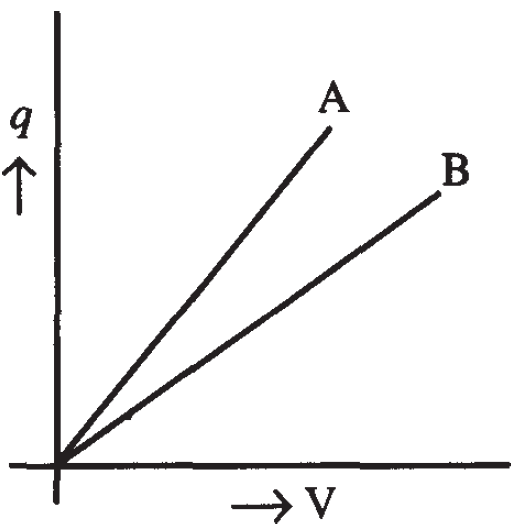
The given graph shows the variation of charge $q$ versus potential difference $V$ for two capacitors $C_1$ and $C_2$. The two capacitors have same plate separation, but the plate area of $C_2$ is double than that of $C_1$. Which of the lines in the graph correspond to $\mathrm{C}_1$ and $\mathrm{C}_2$ and why?
Answer

Line A represents $C_2$ Line B represents $C_1$
$\because \text{C}=\frac{\text{A}\varepsilon_{\circ}}{\text{d}}$
$\therefore \text{C}_{2}= 2\text{C}_{1}$
Also, slope of line $\frac{\text{q}}{\text{V}}=\text{C}$
Line A, of greater slope, corresponds to $C_2$ while line B corresponds to $C_1$.

Need a full question paper?

Generate a complete, print-ready paper with questions like this in minutes — across 16+ boards, with answer keys.

Start Generating Free

Similar questions

If the total mechanical energy of a particle is zero, is its linear momentum necessarily zero? Is it necessarily non-zero?
Explain how does the polarized dielectric modify the original external field inside it ?
Why is the luminous efficiency small for a filament bulb as compared to a mercury vapour lamp?
Does the phrase "direction of zero vector" have physical significance? Discuss in terms of velocity, force etc.
Show that the electrostatic potential is constant throughout the volume of the conductor and has the same value (as inside) on its surface.
Draw a graph from the following data. Draw tangents at x = 2, 4, 6 and 8. Find the slopes of these tangents. Verify that the curve drawn is $y = 2x^2$ and the slope of dy tangent is $\tan\theta=\frac{\text{dy}}{\text{dx}}=4\text{x}.$
x 1 2 3 4 5 6 7 8 9 10
y 2 8 18 32 50 72 98 128 162 200
A small metal sphere with $+Q$ charge is placed in the cavity of a larger uncharged metal sphere. As shown in the Fig. Find the value of electric field intensity at point $P_1$ and $P_2$ from Gauss's law.
In a double slit interference experiment, the separation between the slits is 1.0mm, the wavelength of light used is $5.0 × 10^{-7}m$ and the distance of the screen from the slits is 1.0m.
  1. Find the distance of the centre of the first minimum from the centre of the central maximum.
  2. How many bright fringes are formed in one centimeter width on the screen?
Why does a phonograph-record attract dust particles just after it is cleaned?
A and B are two conducting spheres of equal radius, in which sphere $A$ is solid and sphere $B$ is hollow. Both are charged to the same potential. What will be the relation between the charges on both the spheres?