MCQ
The gradient of velocity v/s time graph is equal to ________.
  • A
    Velocity
  • B
    Acceleration
  • C
    Distance
  • D
    Momentum

Answer

  1. Acceleration

Explanation:

The gradient or slope of any graph tells us the value of its differential at that point.

Since acceleration is the differential of velocity with respect to time, the gradient is equal to the acceleration.

Need a full question paper?

Generate a complete, print-ready paper with questions like this in minutes — across 16+ boards, with answer keys.

Start Generating Free

Similar questions

Four blocks are connected as shown in the fig. on a horizontal frictionless surface of $m_1 = m_2 = m_3 = m_4$ then $T_3/T_4$ will be
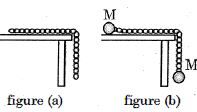
A chain lying on an absolutely smooth table, half of it hanging over the edge of the table as shown in figure $(a)$. The time it takes to slip off the table is affected if two equal weights be attached, one to each end as shown in figure $(b)$ .
$t_a$ : time taken to slip in situation $'a'$
$t_b$ : time taken to slip in situation $'b'$
On a long horizontal belt, a child runs to and fro with a speed of $9\,km/h$ (with respect to the belt) between his father and mother located $50\,m$ apart on the moving belt. The belt moves with a speed of $4\,km/h.$ For an observer on the platform the speed of the child in the direction of motion of the belt is.........$km/h$
Following are four differrent relations about displacement, velocity and acceleration for the motion of a particle in general. Choose the incorrect one (s):
An earth satellite is moving around the earth in a circular orbit. In such case, what is conserved?
A stationary man observes that the rain is falling vertically downward. When he starts running with a velocity of  $12\,\,km/h$ he observes that the rains is falling at an angle $60^o$ with the vertical. The actual velocity of rain is
If $Q , E$ and $W$ denote respectively the heat added, change in internal energy and the work done by a closed cycle process, then
A uniform heavy disc is rotating at constant angular velocity $\omega$ about a vertical axis through its centre and perpendicular to the plane of the disc.  Let $L$ be its angular momentum.  A lump of plasticine is dropped vertically on the disc and sticks to it.  Which will be constant
A vessel of volume V contains a mixture of 1 mole of hydrogen and 1 mole of oxygen (both considered as ideal). Let f1(v)dv denotes the fraction of molecules with speed between v and (v + dv) with f2(v)dv, similarly for oxygen. Then,
Which of the following curves may represent the speed of the electron in a hydrogen atom as a function of the principal quantum number n?