MCQ
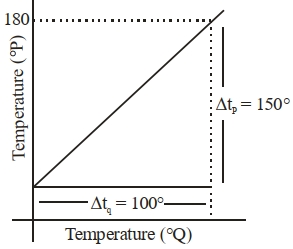
The graph between two temperature scales $P$ and $Q$ is shown in the figure. Between upper fixed point and lower fixed point there are $150$ equal divisions of scale $P$ and $100$ divisions on scale $Q$. The relationship for conversion between the two scales is given by :
  • A
    $\frac{t_Q}{150}=\frac{t_P-180}{100}$
  • $\frac{t_Q}{100}=\frac{t_P-30}{150}$
  • C
    $\frac{t_P}{180}=\frac{t_Q-40}{100}$
  • D
    $\frac{t_P}{100}=\frac{t_Q-180}{150}$
Answer

Correct option: B.
$\frac{t_Q}{100}=\frac{t_P-30}{150}$
b
$\frac{\text { reading on scale }-\text { Lower fixed point }}{\text { upper fixed point }-\text { lower fixed point }}=\text { constant }$

$\frac{t_P-30}{180-30}=\frac{t_Q-0}{100-0}$

$\frac{t_P-30}{150}=\frac{t_Q}{100}$

Need a full question paper?

Generate a complete, print-ready paper with questions like this in minutes — across 16+ boards, with answer keys.

Start Generating Free

Similar questions

The rms speed of oxygen molecule in a vessel at particular temperature is $\left(1+\frac{5}{x}\right)^{\frac{1}{2}} v$, where $v$ is the average speed of the molecule. The value of $x$ will be:(Take $\pi=\frac{22}{7}$ )
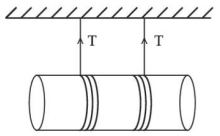
A solid cylinder length is suspended symmetrically through two massless strings, as shown in the figure. The distance from the initial rest position, the cylinder should by unbinding the strings to achieve a speed of $4\,ms ^{-1}$, is$........cm$. $\left(\right.$ take $\left.g=10\,ms ^{-2}\right)$
The electrostatic energy of a nucleus of charge $Z e$ is equal to $\frac{k Z^2 e^2}{R}$, where $k$ is a constant and $R$ is the nuclear radius. The nucleus divides into two daughter nuclei of charges $\frac{Z e}{2}$ and equal radii. The change in electrostatic energy in the process when they are far apart is
A person suffering from 'presbyopia' (myopia and hyper metropia both defects) should use
The relation between the gas pressure $P$ and average kinetic energy per unit volume $E$ is
The sun's diameter is $1.4 \times {10^9}m$ and its distance from the earth is ${10^{11}}m.$ The diameter of its image, formed by a convex lens of focal length $2\,m$ will be.......$cm$
$Assertion$ : The velocity of a body at the bottom of an inclined plane of given height is more when it slides down the plane, compared to, when it rolling down the same plane.
$Reason$ : In rolling down a body acquires both, kinetic energy of translation and rotation
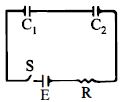
In the following circuit, the switch $S$  is closed at $t = 0.$  The charge on the capacitor  $C_1$  as a function of time will be given by $\left( {{C_{eq}}\, = {\kern 1pt} \,\frac{{{C_1}{C_2}}}{{{C_1} + {C_2}}}} \right).$
An effective power of a combination of $5$ identical convex lenses which are kept in contact along the principal axis is $25 \mathrm{D}$. Focal length of each of the convex lens is:
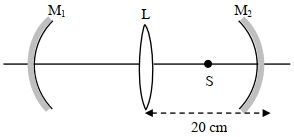
An optical arrangement consists of two concave mirrors $M_1$ and $M_2$, and a convex lens $L$ with a common principal axis, as shown in the figure. The focal length of $L$ is $10 \mathrm{~cm}$. The radii of curvature of $M_1$ and $M_2$ are $20 \mathrm{~cm}$ and $24 \mathrm{~cm}$, respectively. The distance between $\mathrm{L}$ and $M_2$ is $20 \mathrm{~cm}$. A point object $S$ is placed at the mid-point between $L$ and $M_2$ on the axis. When the distance between $\mathrm{L}$ and $M_1$ is $n / 7 \mathrm{~cm}$, one of the images coincides with $S$. The value of $n$ is. . . .