MCQ
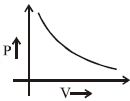
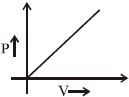
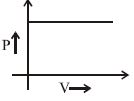
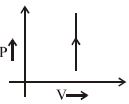
The graph of pressure $(P)$ and volume $(V)$ according to $PV^n = C$, here $n = 1.4$

  • B

  • C

  • D

Answer

Correct option: A.

a
$P = \frac{C}{{{V^{1.4}}}}\, \Rightarrow {\text{Hyperbola}}$

Need a full question paper?

Generate a complete, print-ready paper with questions like this in minutes — across 16+ boards, with answer keys.
Start Generating Free

Similar questions

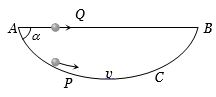
A particle $P$ is sliding down a frictionless hemispherical bowl. It passes the point $A$ at $t = 0$. At this instant of time, the horizontal component of its velocity is $v$. A bead $Q$ of the same mass as $P$ is ejected from $A$ at $t = 0$ along the horizontal string $AB$ (see figure) with the speed $v$. Friction between the bead and the string may be neglected. Let ${t_P}$ and ${t_Q}$ be the respective time taken by $P$ and $Q$ to reach the point $B$. Then
A uniform rope lies on a horizontal table so that a part of it hangs over the edge. The rope begins to slide down when the length of the hanging part is $25\%$ of the entire length. The coefficient of friction between the rope and the table is
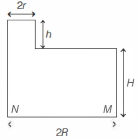
A cylindrical vessel of base radius $R$ and height $H$ has a narrow neck of height $h$ and radius $r$ at one end (see figure). The vessel is filled with water (density $\rho_w$ ) and its neck is filled with immiscible oil (density $\rho_0$ ). Then, the pressure at
A ball is thrown from the ground to clear a wall $3\,m$ high at a distance of $6\,m$ and falls $18\,m$ away from the wall, the angle of projection of ball is
When a body is in the state of complete rest, what kind of energy does it possess?
Equation of a plane progressive wave is given by $\text{y}=0.6\sin2\pi\Big(\text{t}-\frac{\text{x}}{2}\Big).$ On reflection from a denser medium its amplitude becomes 2/3 of the amplitude of the incident wave. The equation of the reflected wave is:
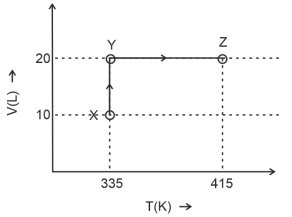
Consider the following volume-temperature $( V - T )$ diagram for the expansion of $5$ moles of an ideal monoatomic gas.

Considering only $P-V$ work is involved, the total change in enthalpy (in Joule) for the transformation of state in the sequence $X \rightarrow Y \rightarrow Z$ is $\qquad$

[Use the given data: Molar heat capacity of the gas for the given temperature range, $C _{ v , m }=12 J K ^{-1} mol ^{-1}$ and gas constant, $R =8.3 J K ^{-1} mol ^{-1}$ ]
A person A can clearly see objects between 25cm and 200cm. Which of the following may represent the range of clear vision for a person B having muscles stronger than A, but all other parameters of eye identical to that of A?
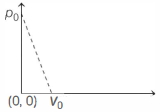
One mole of ideal gas undergoes a linear process as shown in the figure below. Its temperature expressed as a function of volume $V$ is
The dimensions of $emf$ in $MKS$ is