MCQ
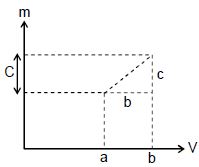
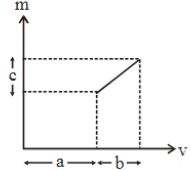
The graph shows how the magnification $m$ produced by a thin lens varies with image distance $v$. What is the focal length of the lens used?
  • A
    $\frac {b^2}{ac}$
  • B
    $\frac {a}{c}$
  • C
    $\frac {b^2c}{a}$
  • $\frac {b}{c}$

Answer

Correct option: D.
$\frac {b}{c}$
d
$f\,=\,\frac {b}{c}$

Need a full question paper?

Generate a complete, print-ready paper with questions like this in minutes — across 16+ boards, with answer keys.
Start Generating Free

Similar questions

Interference was observed in interference chamber when air was present, now the chamber is evacuated and if the same light is used, a careful observer will see
A charged conductor has its charge only on its outer surface. This statement is true for which of the following?
The refractive index of water with respect to air is $4 / 3$ and the refractive index of glass with respect to air is $3/2$. The refractive index of water with respect to glass is
A smal fish $0.4\,m$ below the surface of a lake , is viewed through a simple converging lesn of focal length $3\,m.$ The lens is kept at $0.2\, m$ above the water surface such that fish lies on the optical axis of the lens. The image of the fish seen by oserver will be at  $\left( {{\mu _{water}} = \frac{4}{3}} \right)$
A person wears glasses of power $-2.0 \,D$. The defect of the eye and the far point of the person without the glasses will be
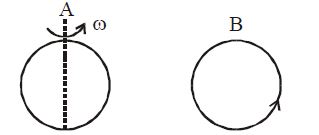
There are two coils $A$ and $B$ as shown in figure. No current flows in $B$ if $A$ is at rest. Now the coil $A$ is made to rotate about a vertical axis. At the shown instant $(t = 0)$ what will be the current in coil $A$,  hen the current in $B$ is counterclockwise?
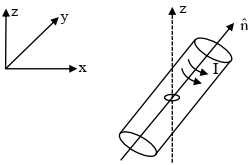
A small circular loop of area $A$ and resistance $R$ is fixed on a horizontal $x y$-plane with the center of the loop always on the axis $\hat{n}$ of a long solenoid. The solenoid has $m$ turns per unit length and carries current $I$ counterclockwise as shown in the figure. The magnetic field due to the solenoid is in $\hat{ n }$ direction. $List-I$ gives time dependences of $\hat{ n }$ in terms of a constant angular frequency $\omega$.

$List-II$ gives the torques experienced by the circular loop at time $t=\frac{\pi}{6 \omega}$, Let $\alpha=\frac{A^2 \mu_0^2 m^2 I^2 \omega}{2 R}$.

$List-I$ $List-II$
($I$) $\frac{1}{\sqrt{2}}(\sin \omega t \hat{j}+\cos \omega t \hat{k})$ ($P$) $0$
($II$) $\frac{1}{\sqrt{2}}(\sin \omega t \hat{j}+\cos \omega t \hat{k})$ ($Q$) $-\frac{\alpha}{4} \hat{i}$
($III$) $\frac{1}{\sqrt{2}}(\sin \omega t \hat{j}+\cos \omega t \hat{k})$ ($R$) $\frac{\alpha}{4} \hat{j}$
($IV$) $\frac{1}{\sqrt{2}}(\sin \omega t \hat{j}+\cos \omega t \hat{k})$ ($S$) $\frac{\alpha}{4} \hat{j}$
  ($T$) $-\frac{3 \alpha}{4} \hat{i}$

Which one of the following options is correct?
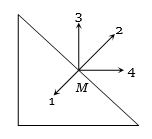
Three identical point charges, as shown are placed at the vertices of an isosceles right angled triangle. Which of the numbered vectors coincides in direction with the electric field at the mid-point $M$ of the hypotenuse
In a current carrying long solenoid, the field produced does not depend upon
When the resistance $R$ (indicated in the figure below) is changed from $1 \,k \Omega$. to $10 \,k \Omega$, the current flowing through the resistance $R'$ does not change. What is the value of the resistor $R'?$