MCQ
In a current carrying long solenoid, the field produced does not depend upon
  • A
    Number of turns per unit length
  • B
    Current flowing
  • Radius of the solenoid
  • D
    All of the above three

Answer

Correct option: C.
Radius of the solenoid
c
The magnetic field at the center of solenoid is given as:

$B =\mu_0 ni$

where $n$ is number of turns per unit length $=\frac{ N }{ l }$

$i$ is the current through the solenoid.

So, the magnetic field does not depend on the radius of the solenoid.

Need a full question paper?

Generate a complete, print-ready paper with questions like this in minutes — across 16+ boards, with answer keys.
Start Generating Free

Similar questions

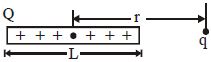
A charge $Q$ is distributed over a line of length $L.$ Another point charge $q$ is placed at a distance $r$ from the centre of the line distribution. Then the force expericed by $q$ is
A current of $10\, A$ exists in a wire of crosssectional area of $5\, mm ^{2}$ with a drift velocity of $2 \times 10^{-3}\, ms ^{-1}$. The number of free electrons in each cubic meter of the wire is ..........
In an elastic collision:
Period of revolution increases in the order of
If the binding energy of the deutrium is 2.23 MeV. The mass defect given in a.m.u. is
Two identical conducting spheres $\mathrm{P}$ and $\mathrm{S}$ with charge $Q$ on each, repel each other with a force $16 \mathrm{~N}$. A third identical uncharged conducting sphere $\mathrm{R}$ is successively brought in contact with the two spheres. The new force of repulsion between $\mathrm{P}$ and $\mathrm{S}$ is :
The magnetic field associated with a light wave is given, at the origin, by

$B = B_0 [sin\,(3.14 \times 10^7)\,ct\,+\,sin\,(6.28 \times 10^7)\,ct]$

If this light falls on a silver plate having a work function of $4.7\,eV,$ what will be the maximum kinetic energy of the photo electrons? .............. $eV$

Two particles $A_1$ sand $A_2$ of masses $m_1, m_2\left(m_1>m_2\right)$ have the same de$-$Broglie wavelength. Then:
Parallel rays are incident on a transparent sphere along its one diameter. After refrection these rays converge at the other end of this diameter the refractive index of the sphere is
The photoelectric threshold of Tungsten is $2300\; \mathring A$. The energy of the electrons ejected from the surface by ultraviolet light of wavelength $1800\; \mathring A$ is $.............\,eV$