MCQ
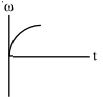
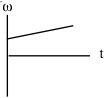
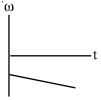
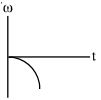
The graphs below show angular velocity as a function of time. In which one is the magnitude of the angular acceleration constantly decreasing?

  • B

  • C

  • D

Answer

Correct option: A.

a

Need a full question paper?

Generate a complete, print-ready paper with questions like this in minutes — across 16+ boards, with answer keys.

Start Generating Free

Similar questions

For an ideal gas
Four blocks are connected as shown in the fig. on a horizontal frictionless surface of $m_1 = m_2 = m_3 = m_4$ then $T_3/T_4$ will be
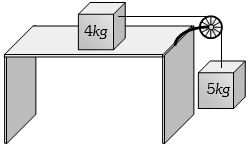
Two masses of $4\, kg$ and $5 \,kg$ are connected by a string passing through a frictionless pulley and are kept on a frictionless table as shown in the figure. The acceleration of $5\, kg$ mass is  ........... $m/s^2$
As one considers orbits with higher values of $n$ in a hydrogen atom, the electric potential energy of the atom:
The product of resistivity and conductivity of a cylindrical conductor depends on:
A weight of $200 \,kg$ is suspended by vertical wire of length $600.5\, cm$. The area of cross-section of wire is $1\,m{m^2}$. When the load is removed, the wire contracts by $0.5 \,cm$. The Young's modulus of the material of wire will be
The value closest to the thermal velocity of a Helium atom at room temperature $(300\,K)$in $ms^{-1}$ is $[k_B\, = 1 .4\times10^{-23}\,J/K;\, m_{He}\, = 7\times10^{-27}\,kg]$
A particle $(A)$ is dropped from a height and another particle $(B)$ is thrown in horizontal direction with speed of $5\; m/sec$ from the same height. The correct statement is
An $80\, kg$ person is parachuting and is experiencing a downward acceleration of $2.8\, m/s^2$. The mass of the parachute is $5\, kg$. The upward force on the open parachute is  ........... $N$ (Take $g = 9.8\, m/s^2$)
If $\Delta Q$ and $\Delta W$ represent the heat supplied to the system and the work done on the system respectively, then the first law of thermodynamics can be written as