MCQ
For an ideal gas
  • A
    The change in internal energy in a constant pressure process from temperature $T_1$ to $T_2$ is equal to $nC_v (T_2 -T_1)$ where$C _v$ is the molar specific heat at constant volume andnis the number of the moles of the gas.
  • B
    The change in internal energy of the gas and the work done by the gas are equal in magnitude in an adiabatic proces.
  • C
    The internal energy does not change in an isothermal process.
  • $A, B$ and $C$

Answer

Correct option: D.
$A, B$ and $C$
d

Need a full question paper?

Generate a complete, print-ready paper with questions like this in minutes — across 16+ boards, with answer keys.

Start Generating Free

Similar questions

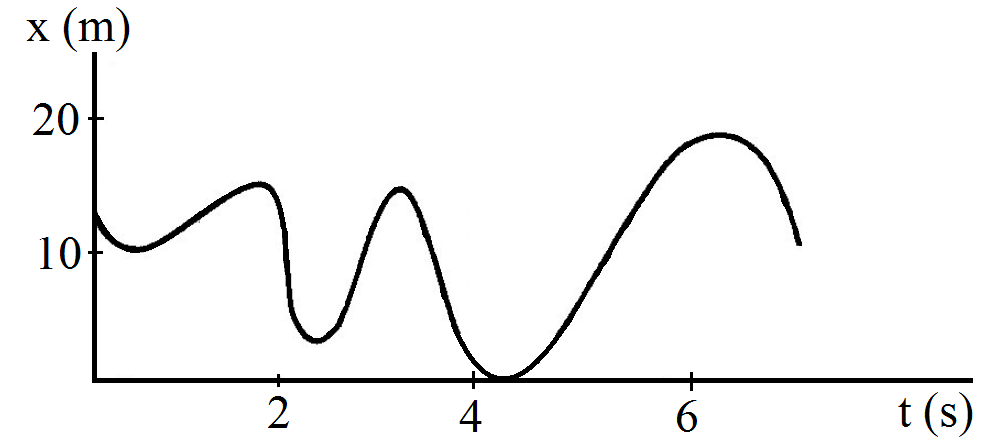
Figure shows the position of a particle moving on the $X-$axis as a function of time.
A stationary rocket of initial mass $m_0$ is expelling exhaust gas at a steady speed $v$. with respect to itself There is no external force on rocket. When its mass is reduced to $\frac{{{m_0}}}{2}$ , the velocity attained by rocket will be
A porter lifts a heavy suitcase of mass $80\, {kg}$ and at the destination lowers it down by a distance of $80\, {cm}$ with a constant velocity. Calculate the workdone by the porter in lowering the suitcase. (take $g=9.8\, {ms}^{-2}$ ) (In ${J}$)
A long spring is stretched by $2\ cm$ and its potential energy is $V.$ If the spring is stretched by $10\ cm,$ its potential energy will be:
An earthquake generates both transverse $(S)$ and longitudinal $(P)$ sound waves in the earth. The speed of $S$ waves is about $4.5 \,km/s$ and that of $P$ waves is about $8.0 \,km/s.$ A seismograph records $P$ and $S$ waves from an earthquake. The first $P$ wave arrives $4.0\, min$ before the first $S$ wave. The epicenter of the earthquake is located at a distance about .... $km$
The random error in the arithmetic mean of $100$ observations is $x$; then random error in the arithmetic mean of $400$ observations would be
The moment of inertia of semicircular ring about its centre is
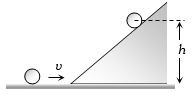
A disc of mass $M$ and radius $R$ rolls in a horizontal surface and then rolls up an inclined plane as shown in the fig. If the velocity of the disc is $v$, the height to which the disc will rise will be..
$A$ and $B$ are two wires. The radius of $A$ is twice that of $B.$ They are stretched by the same load. Then, the stress on $B$ is:
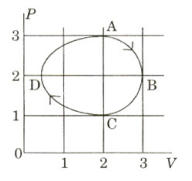
The figure shows the $P-V$ plot of an ideal gas taken through a cycle $ABCDA$. The part $ABC$ is a semi-circle and $CDA$ is half of an ellipse. Then,

$(A)$ the process during the path $\mathrm{A} \rightarrow \mathrm{B}$ is isothermal

$(B)$ heat flows out of the gas during the path $\mathrm{B} \rightarrow \mathrm{C} \rightarrow \mathrm{D}$

$(C)$ work done during the path $\mathrm{A} \rightarrow \mathrm{B} \rightarrow \mathrm{C}$ is zero

$(D)$ positive work is done by the gas in the cycle $ABCDA$