MCQ
The graphs in figure show that a quantity $y$ varies with displacement $d$ in a system undergoing simple harmonic motion. Which graphs best represents the relationship obtained when $y$ is The time

  • A
    $I$
  • B
    $II$
  • C
    $III$
  • $IV$

Answer

Correct option: D.
$IV$
d
Distance versus time curve is like the rotated curve $IV$ for an $SHM$ since distance follows a $wave-lke$ path about the mean position. Thus $time-displacement$ curve will be it's rotated version, or curve $IV$

Need a full question paper?

Generate a complete, print-ready paper with questions like this in minutes — across 16+ boards, with answer keys.

Start Generating Free

Similar questions

A nucleus $X$ undergoes following transformation

$X \stackrel{a}{\longrightarrow} Y$

$Y \underset{2 \beta}{\longrightarrow} Z$

then
A ball is launched from the top of Mt. Everest which is at elevation of $9000 \,m$. The ball moves in circular orbit around earth. Acceleration due to gravity near the earth's surface is $g$. The magnitude of the ball's acceleration while in orbit is
Two sound waves of slightly different frequencies have amplitude ratio $\frac{11}{9} .$ What is the difference of sound levels in decibels of maximum and minimum intensities heard at a point :- ............. $\mathrm{dB}$
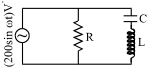
In the circuit diagram shown, $X_C = 100 \Omega$ ,$ X_L = 200 \Omega$ and $R = 100 \Omega $. The effective current through the source is.....$A$
Time period of revolution of an electron in $n^{\text {th}}$ orbit in a hydrogen like atom is given by $T=\frac{T_0 n^a}{Z^b} \cdot Z=$ atomic number
The length of a rod is $20\, cm$ and area of cross-section $2\,c{m^2}$. The Young's modulus of the material of wire is $1.4 \times {10^{11}}\,N/{m^2}$. If the rod is compressed by $5\, kg-wt$ along its length, then increase in the energy of the rod in joules will be
The wave equation is $y = 0.30\sin (314t - 1.57x)$ where $t, x$ and $y$ are in second, meter and centimeter respectively. The speed of the wave is ..... $m/s$
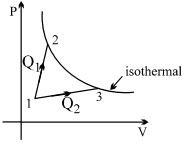
A gas takes part in two processes in which it is heated from the same initial state $1$ to the same final temperature. The processes are shown on the $P-V$ diagram by the straight line $1-2$ and $1-3$. $2$ and $3$ are the points on the same isothermal curve. $Q_1$ and $Q_2$ are the heat transfer along the two processes. Then
If $x=10.0 \pm 0.1$ and $y=10.0 \pm 0.1$, then $2 x-2 y$ is equal to
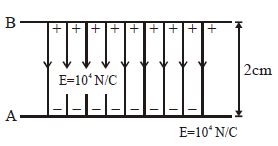
An electron is released from the bottom plate $A$ as shown in the figure $(E = 10^4\, N/C)$. The velocity of the electron when it reaches plate $B$ will be nearly equal to