The length of a rod is $20\, cm$ and area of cross-section $2\,c{m^2}$. The Young's modulus of the material of wire is $1.4 \times {10^{11}}\,N/{m^2}$. If the rod is compressed by $5\, kg-wt$ along its length, then increase in the energy of the rod in joules will be
Medium


Download our appand get started for free
Experience the future of education. Simply download our apps or reach out to us for more information. Let's shape the future of learning together!No signup needed.*
Similar Questions
- 1A steel wire $1.5\,m$ long and of radius $1\,mm$ is attached with a load $3\,kg$ at one end the other end of the wire is fixed it is whirled in a vertical circle with a frequency $2\,Hz$ . Find the elongation of the wire when the weight is at the lowest position $(Y = 2 \times 10^{11}\,N/m^2$ and $g = 10\,m/s^2)$View Solution
- 2View SolutionAccording to Hook’s law of elasticity, if stress is increased, the ratio of stress to strain
- 3View SolutionDue to addition of impurities, the modulus of elasticity
- 4A uniform metal rod of $2\,\,mm^2$ cross section fixed between two walls is heated from $0\,^oC$ to $20\,^oC$ . The coefficient of linear expansion of rod is $12\,\,\times\,\,10^{-6}\,/^oC$ . Its Young's modulus of elasticity is $10^{11}\,\,N/m^2$ . The energy stored per unit volume of rod will be ....... $J/m^3$View Solution
- 5A metallic rod of length $I$ and cross-sectional area $A$ is made of a material of Young's modulus $Y$. If the rod is elongated by an amount $y$, then the work done is proportional to ......View Solution
- 6The work done per unit volume to stretch the length of area of cross-section $2 \,mm ^2$ by $2 \%$ will be ....... $MJ / m ^3$ $\left[Y=8 \times 10^{10} \,N / m ^2\right]$View Solution
- 7To determine Young's modulus of a wire, the formula is $Y = \frac{F}{A}.\frac{L}{{\Delta L}}$ where $F/A$ is the stress and $L/\Delta L$ is the strain. The conversion factor to change $Y$ from $CGS$ to $MKS$ system isView Solution
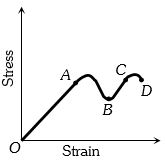
- 8View SolutionA graph is shown between stress and strain for a metal. The part in which Hooke's law holds good is
- 9A body of mass $\mathrm{m}=10\; \mathrm{kg}$ is attached to one end of a wire of length $0.3\; \mathrm{m} .$ The maximum angular speed (in $rad \;s^{-1}$ ) with which it can be rotated about its other end in space station is (Breaking stress of wire $=4.8 \times 10^{7} \;\mathrm{Nm}^{-2}$ and area of cross-section of the wire $=10^{-2}\; \mathrm{cm}^{2}$ ) isView Solution
- 10A uniform copper rod of length $50 \,cm$ and diameter $3.0 \,mm$ is kept on a frictionless horizontal surface at $20^{\circ} C$. The coefficient of linear expansion of copper is $2.0 \times 10^{-5} \,K ^{-1}$ and Young's modulus is $1.2 \times 10^{11} \,N / m ^2$. The copper rod is heated to $100^{\circ} C$, then the tension developed in the copper rod is .......... $\times 10^3 \,N$View Solution