Question
The gravitational attraction between electron and proton in a hydrogen atom is weaker than the coulomb attraction by a factor of about $10^{–40}$. An alternative way of looking at this fact is to estimate the radius of the first Bohr orbit of a hydrogen atom if the electron and proton were bound by gravitational attraction. You will find the answer interesting.
Answer

Radius of the first Bohr orbit is given by the relation,
$\text{r}_1=\frac{4\pi\in_0\Big(\frac{\text{h}}{2\pi}\Big)^2}{\text{m}_\text{e}\text{e}^2}\ \dots(1)$
Where,
$\in_0 =$ Permittivity of free space
$h =$ Planck ' s constant $= 6.63 \times 10^{-34} Js$
$me =$ Mass of an electron $= 9.1 \times 10^{-31}kg$
$e =$ Charge of an electron $= 1.9 \times 10^{-19} C$
$mp =$ Mass of a proton $= 1.67 \times 10^{-27} \ kg$
$r =$  Distance between the electron and the proton
Coulomb attraction between an electron and a proton is given as:
$\text{F}_\text{C}=\frac{\text{e}^2}{4\pi\in_0\text{r}^2}\ \dots(2)$
Gravitational force of attraction between an electron and a proton is given as:
$\text{F}_\text{G}=\frac{\text{Gm}_\text{p}\text{m}_\text{c}}{\text{r}^2}\ \dots(3)$
Where,
$G =$ Gravitational constant $= 6.67 \times 10^{-11} N m^{2 }/ \ kg^2$
If the electrostatic $($Coulomb$)$ force and the gravitational force between an electron and a proton are equal, then we can write:
$\therefore\ \text{FG}=\text{FC}$
$\frac{\text{Gm}_\text{p}\text{m}_\text{c}}{\text{r}^2}=\frac{\text{e}^2}{4\pi\in_0\text{r}^2}$
$\therefore\ \frac{\text{e}^2}{4\pi\in_0}=\text{Gm}_\text{p}\text{m}_\text{c}\ \dots(4)$
Putting the value of equation $(4)$ in equation $(1),$ we get:
$\text{r}_1=\frac{\Big(\frac{\text{h}}{2\pi}\Big)^2}{\text{Gm}_\text{p}\text{m}_\text{e}^2}$
$=\frac{\Big(\frac{6.63\times10^{-34}}{2\times3.14}\Big)^2}{6.67\times10^{-11}\times1.67\times10^{-27}\times(9.1\times10^{-31})^2}\approx1.21\times10^{29}\text{ m}$
It is known that the universe is $156$ billion light years wide or $1.5 \times 10^{27} m$ wide.
Hence, we can conclude that the radius of the first Bohr orbit is much greater than the estimated size of the whole universe.

Need a full question paper?

Generate a complete, print-ready paper with questions like this in minutes — across 16+ boards, with answer keys.

Start Generating Free

Similar questions

An object is placed at a distance of 30cm from a converging lens of focal length 15cm. A normal eye (near point 25cm, far point infinity) is placed close to the lens on the other side.
  1.  Can the eye see the object clearly?
  2.  What should be the minimum separation between the lens and the eye so that the eye can clearly see the object?
  3.  Can a diverging lens, placed in contact with the converging lens, help in seeing the object clearly when the eye is close to the lens?
Consider the situation of the previous problem.
  1. Calculate the force needed to keep the sliding wire moving with a constant velocity v.
  2. If the force needed just after $t = 0$ is $F_0$, find the time at which the force needed will be $\frac{\text{F}_0}{2}.$
A box weighing 2000N is to be slowly slid through 20m on a straight track having friction coefficient 0.2 with the box.
  1. Find the work done by the person pulling the box with a chain at an angle $\theta $ with the horizontal.
  2. Find the work when the person has chosen a value of $\theta $ which ensures him the minimum magnitude of the force.
A proton goes undeflected in a crossed electric and magnetic field $($the fields are perpendicular to each other$)$ at a speed of $2.0 \times 10^5ms^{-1}.$ The velocity is perpendicular to both the fields. When the electric field is switched off, the proton moves along a circle of radius $4.0\ cm.$ Find the magnitudes of the electric and magnetic fields. Take the mass of the proton $= 1.6 \times 10^{-27}kg$
A parallel plate capacitor is to be designed with a voltage rating $1kV,$ using a material of dielectric constant $3$ and dielectric strength about $10^7Vm^{–1}.\  ($Dielectric strength is the maximum electric field a material can tolerate without breakdown, i.e., without starting to conduct electricity through partial ionisation.$)$ For safety, we should like the field never to exceed, say $10\%$ of the dielectric strength. What minimum area of the plates is required to have a capacitance of $50pF$ ?
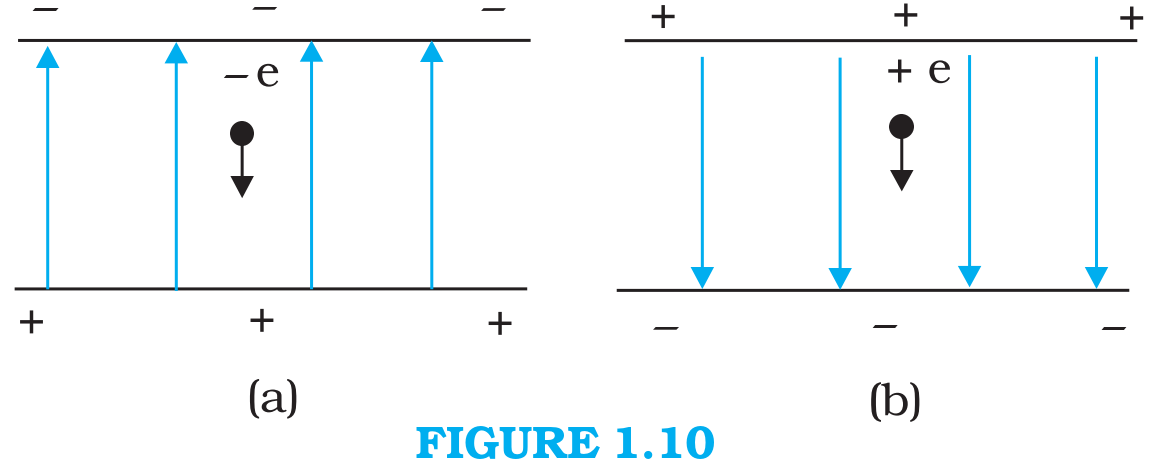
An electron falls through a distance of $1.5 \ cm$ in a uniform electric field of magnitude $2.0 \times 10^4 N C ^{-1} [$Fig. $1.10(a)]$. The direction of the field is reversed keeping its magnitude unchanged and a proton falls through the same distance $ [$Fig. $1.10(b)].$ Compute the time of fall in each case. Contrast the situation with that of 'free fall under gravity'.
Image
An object 1.5 cm in size is placed on the side of the convex lens in the arrangement (a) above. The distance between the object and the convex lens is 40 cm. Determine the magnification produced by the two-lens system, and the size of the image.
A compound microscope consists of an objective lens of focal length $2.0 \ cm$ and an eyepiece of focal length $6.25 \ cm$ separated by a distance of $15 \ cm$. How far from the objective should an object be placed in order to obtain the final image at
a.the least distance of distinct vision $(25 \ cm),$ and
$b$. at infinity?
What is the magnifying power of the microscope in each case?
Two wires of equal length, one of aluminium and the other of copper have the same resistance. Which of the two wires is lighter? Hence explain why aluminium wires are preferred for overhead power cables.
$(\rho_{\text{A}1}=2.63\times10^{-8}\Omega\ \text{m,}$ Relative density of $Al=2.7,\ \text{of Cu}=8.9)$
  1. Draw the ray diagram showing refraction of light through a glass prism and hence obtain the relation between the refractive index $\mu$ of the prism, angle of prism and angle of minimum deviation.
  2. Determine the value of the angle of incidence for a ray of light travelling from a medium of refractive index $\mu_1=\sqrt{2}$ into the medium of refractive index $\mu_2=1$, so that it just grazes along the surface of separation.