Question
A parallel plate capacitor is to be designed with a voltage rating $1kV,$ using a material of dielectric constant $3$ and dielectric strength about $10^7Vm^{–1}.\  ($Dielectric strength is the maximum electric field a material can tolerate without breakdown, i.e., without starting to conduct electricity through partial ionisation.$)$ For safety, we should like the field never to exceed, say $10\%$ of the dielectric strength. What minimum area of the plates is required to have a capacitance of $50pF$ ?
Answer

Potential rating of a parallel plate capacitor $, V = 1kV= 1000V$
Dielectric constant of a matertal, $\epsilon_{\text{r}}={3}$
Dielectric strength $={10}^{7}\frac{\text{V}}{\text{m}}$
For safety, the field intensity never exceeds $10\%$ of the dielectric strength.
Hence, electric field intensity $, E = 10\% of 10^7 = 10^6$ $\frac{\text{V}}{\text{m}}$
Capacitance of the parallel plate capacitor $, C = 50pf = 50 \times 10^{-12}F$
Distance between the plates is given by,$\text{d}=\frac{\text{V}}{\text{E}}$
$=\frac{1000}{{10}^{6}}={10}^{-3}\text{m}$
Capacitance i given by the relation, $\text{C}=\frac{\epsilon_{0}\epsilon_{\text{r}\text{A}}}{\text{d}}$ where $, A =$ Area of each plate $\epsilon_{0} =$ Permittivity of free space $= 8.85 \times 10^{-12} N^{-1} C^2 m^{-2}$
$\therefore\ \text{A}=\frac{\text{Cd}}{\epsilon_{0}\epsilon_{\text{r}}}$
$=\frac{{50}\times{10}^{-12}\times{10}^{-3}}{{8.85}\times{10}^{-12}\times{3}}\approx{19}\text{cm}^{2}$
Hence, the area of each plate is about $19\ cm^2$.

Need a full question paper?

Generate a complete, print-ready paper with questions like this in minutes — across 16+ boards, with answer keys.

Start Generating Free

Similar questions

A projectile is fired with a speed u at an angle $\theta$ above a horizontal field. The coefficient of restitution of collision between the projectile and the field is e. How far from the starting point, does the projectile makes its second collision with the field?
Three particles of masses 1.0kg, 2.0kg and 3.0kg are placed at the corners A, B and C respectively of an equilateral triangle ABC of edge 1m. Locate the centre of mass of the system.
A biconvex thick lens is constructed with glass $(\mu=1.50)$ Each of the surfaces has a radius of $10\ cm$ and the thickness at the middle is $5\ cm.$ Locate the image of an object placed far away from the lens.
What is called a capacitor? Explain its principle. Find the formula for combination of capacitors in parallel and series.###Define capacitor. Establish the formula of resultant capacitance in its series and parallel combination. Also draw the necessary circuit diagram.###Define capacitor. How can we increase its capacity? Establish the formula for combining capacitors in parallel and series.
An electron of kinetic energy 100eV circulates in a path of radius 10cm in a magnetic field. Find the magnetic field and the number of revolutions per second made by the electron.
Consider a non-conducting plate of radius r and mass m that has a charge q distributed uniformly over it. The plate is rotated about its axis with an angular speed $\omega.$ Show that the magnetic moment $\mu$ and the angular momentum of the plate are related as $\mu=\frac{\text{q}}{2\text{m}}\text{l}.$
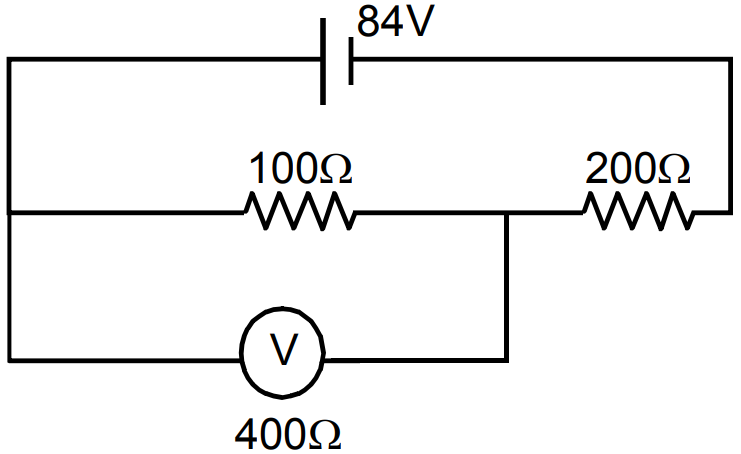
A voltmeter of resistance $400\Omega$ is used to measure the potential difference across the $100\Omega$ resistor in the circuit shown in the figure. (a) What will be the reading of the voltmeter? (b) What was the potential difference across $100\Omega$ before the voltmeter was connected?
An optical instrument used for angular magnification has a $25D$ objective and a $20D$ eyepiece. The tube length is $25\ cm$ when the eye is least strained.
  1. Whether it is a microscope or a telescope?
  2. What is the angular magnification produced?
The energy of a silver atom with a vacancy in $K$ shell is $25.31\ keV,$ in $L$ shell is $3.56\ keV$ and in $M$ shell is $0.530\ keV$ higher than the energy of the atom with no vacancy. Find the frequency of $\text{K}_\alpha\text{K}_\beta$ and $\text{L}_\alpha\ X-$rays of silver.
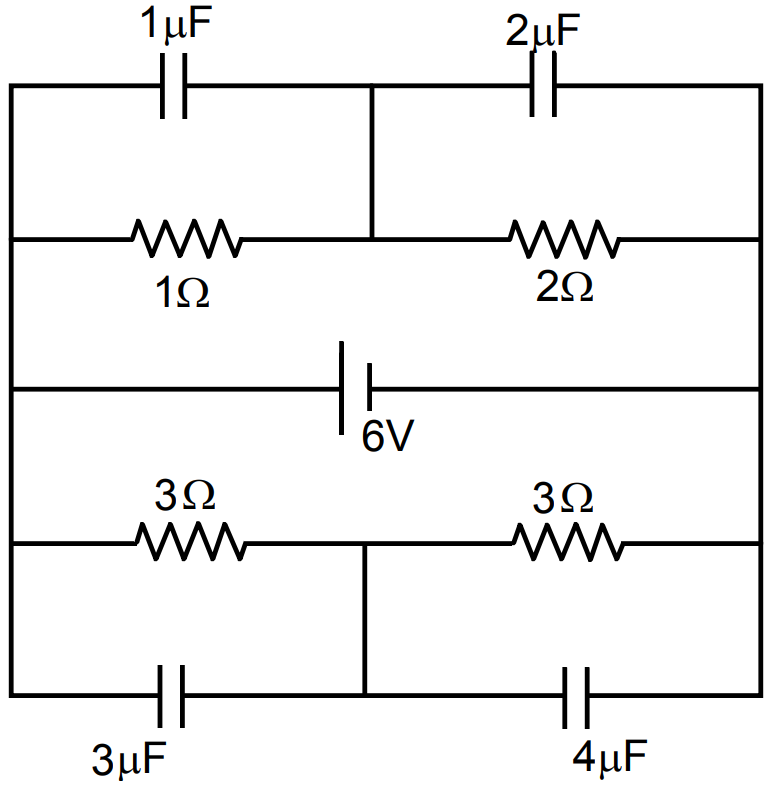
Find the charges on the four capacitors of capacitances $1\mu\text{F},2\mu\text{F},3\mu\text{F}$ and $4\mu\text{F}$ shown in the figure.