MCQ
The gravitational constant depends upon .........
  • A
    Size of the bodies
  • B
    Gravitational mass
  • C
    Distance between the bodies
  • None of these

Answer

Correct option: D.
None of these
d
(d)

Gravitational constant ' $G$ ' is independent of size of bodies, gravitational mass and distance between the bodies.

Need a full question paper?

Generate a complete, print-ready paper with questions like this in minutes — across 16+ boards, with answer keys.

Start Generating Free

Similar questions

In the absence of intermolecular force of attraction, the observed pressure $P$ will be
If it takes $5\,minutes$ to fill a $15\,litre$ bucket from a water tap of diameter $\frac{2}{{\sqrt \pi  }}cm$ then the Reynolds number for the flow is (density of water $= 10^3\,kg/m^3$ ) and viscosity of water $= 10^{-3}\,Pa.s$ ) close to
A copper wire of length $1\, m$ and radius $1\, mm$ is joined in series with an iron wire of length $2\, m$ and radius $3\, mm$ and a current is passed through the wires. The ratio of the current density in the copper and iron wires is
A parallel plate capacitor is made of two circular plates separated by a distance $5\ mm$ and with a dielectric of dielectric constant $2.2$ between them. When the electric field in the dielectric is $3 \times 10^4$ $ Vm^{-1}$ the charge density of the positive plate will be close to
Assertion : Radio waves can be polarised.

Reason : Sound waves in air are longitudinal in nature.
A stone is dropped in a well which is $19.6\,m$ deep. Echo sound is heard after $2.06\, sec$ (after dropping) then the velocity of sound is .... $m/sec$
If you are provided a set of resistances $2\, \Omega, 4\, \Omega$ $6\, \Omega$ and $8\, \Omega$. Connect these resistances so as to obtain an equivalent resistance of $\frac{46}{3}\, \Omega$.
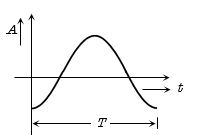
Acceleration $A$ and time period $T$ of a body in $S.H.M.$ is given by a curve shown below. Then corresponding graph, between kinetic energy $(K.E.)$ and time $t$ is correctly represented by
Two capillaries of same length and radii in the ratio $1 : 2$  are connected in series. A liquid flows through them in streamlined condition. If the pressure across the two extreme ends of the combination is $ 1 m$  of water, the pressure difference across first capillary is...... $m$
$A$ certain prism is found to produce a minimum deviation of $38^o$. It produces a deviation of $44^o$ when the angle of incidence is either $42^o$ or $62^o$. What is the angle of incidencewhen it is undergoing minimum deviation?......$^o$