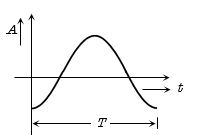
Acceleration $A$ and time period $T$ of a body in $S.H.M.$ is given by a curve shown below. Then corresponding graph, between kinetic energy $(K.E.)$ and time $t$ is correctly represented by
Medium
Download our app for free and get started
(a) In $S.H.M.$ when acceleration is negative maximum or positive maximum, the velocity is zero so kinetic energy is also zero.
Similarly for zero acceleration, velocity is maximum so kinetic energy is also maximum.

Download our appand get started for free
Experience the future of education. Simply download our apps or reach out to us for more information. Let's shape the future of learning together!No signup needed.*
Similar Questions
- 1The displacement of an object attached to a spring and executing simple harmonic motion is given by $ x= 2 \times 10^{-9}$ $ cos$ $\;\pi t\left( m \right)$ .The time at which the maximum speed first occurs isView Solution
- 2The displacement of a particle executing periodic motion is given by :View Solution
$y = 4cos^2\,(t/2)sin\,(1000t)$
This expression may be considered to be a result of superposition of - 3Match $List - I$ with $List - II$View Solution
Choose the correct answer from the options given below

- 4A body executing simple harmonic motion has a maximum acceleration equal to $ 24\,metres/se{c^2} $ and maximum velocity equal to $ 16\;metres/sec $. The amplitude of the simple harmonic motion isView Solution
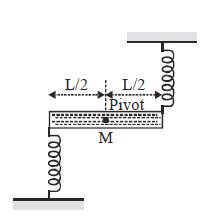
- 5A uniform stick of mass $M$ and length $L$ is pivoted at its centre. Its ends are tied to two springs each of force constant $K$ . In the position shown in figure, the strings are in their natural length. When the stick is displaced through a small angle $\theta $ and released. The stickView Solution
- 6A circular disc of mass $10 \;kg$ is suspended by a wire attached to its centre. The wire is twisted by rotating the disc and released. The period of torsional oscillations is found to be $1.5 \;s$. The radius of the disc is $15\; cm .$ Determine the torsional spring constant of the wire in $N\;m\;rad^{-1}$. (Torsional spring constant $\alpha$ is defined by the relation $J=-\alpha \theta,$ where $J$ is the restoring couple and $\theta$ the angle of twist).View Solution
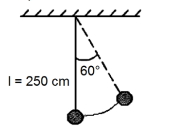
- 7A pendulum is suspended by a string of length $250\,cm$. The mass of the bob of the pendulum is $200\,g$. The bob is pulled aside until the string is at $60^{\circ}$ with vertical as shown in the figure. After releasing the bob. the maximum velocity attained by the bob will be________ $ms ^{-1}$. (if $g=10\,m / s ^{2}$ )View Solution
- 8A mass at the end of a spring executes harmonic motion about an equilibrium position with an amplitude $A.$ Its speed as it passes through the equilibrium position is $V.$ If extended $2A$ and released, the speed of the mass passing through the equilibrium position will beView Solution
- 9The kinetic energy of a particle executing $S.H.M.$ is $16\, J$ when it is in its mean position. If the amplitude of oscillations is $25\, cm$ and the mass of the particle is $5.12\, kg$, the time period of its oscillation isView Solution
- 10Two simple harmonic motions are represented by the equations ${y_1} = 0.1\sin \left( {100\pi t + \frac{\pi }{3}} \right)$ and ${y_2} = 0.1\cos \pi t.$ The phase difference of the velocity of particle $1$ with respect to the velocity of particle $2$ isView Solution