MCQ
The gravitational force ${F_g}$ between two objects does not depend on
  • Sum of the masses
  • B
    Product of the masses
  • C
    Gravitational constant
  • D
    Distance between the masses

Answer

Correct option: A.
Sum of the masses
a
(a) $F_Gravitational$ $=\mathrm{F}=\left[\left(\mathrm{G} \cdot \mathrm{m}_{1} \cdot \mathrm{m}_{2}\right) / \mathrm{D}_{2}\right]$

$\mathrm{m}_{1}, \mathrm{m}_{2}$ are masses of bodies and $\mathrm{D}$ is distance between them.

$\mathrm{G}=$ Gravitational constant.

Need a full question paper?

Generate a complete, print-ready paper with questions like this in minutes — across 16+ boards, with answer keys.
Start Generating Free

Similar questions

Consider a planet in some solar system which has a mass double the mass of earth and density equal to the average density of earth. If the weight of an object on earth is ${W}$, then weight of the same object on that planet will be
Which of the following transitions in hydrogen atoms emit photons of highest frequency?
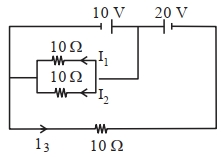
In the given circuit the value of $\left|\frac{I_1+I_3}{I_2}\right|$ is
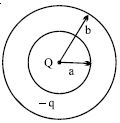
Aspherical shell with an inner radius $'a'$ and an outer radius $'b' $ is made of conducting material. Apoint charge $+Q$ is placed at the centre of the spherical shell and a total charge $- q $ is placed on the shell.

Assume that the electrostatic potential is zero at an infinite distance from the spherical shell. The electrostatic potential at a distance $R$ $(a < R < b)$ from the centre of the shell is (where $K = $ $\frac{1}{{4\pi {\varepsilon _0}}}$)
Assertion : When ultraviolet light is incident on a photocell, its stopping potential is $V_0$ and the maximum kinetic energy of the photoelectrons is $K_{max}$ .When the ultraviolet light is replaced by $X-$ rays, both $V_0$ and $K_{max}$ increase.
Reason : Photoelectrons are emitted with speeds ranging from zero to a maximum value because of the range of frequencies present in the incident light.
Consider two hot bodies ${B_1}$ and ${B_2}$ which have temperatures ${100^o}C$ and ${80^o}C$ respectively at $t = 0$. The temperature of the surroundings is ${40^o}C$. The ratio of the respective rates of cooling ${R_1}$ and ${R_2}$ of these two bodies at $t = 0$ will be
In the middle of the depletion layer of a reverse-biased $PN$ junction, the
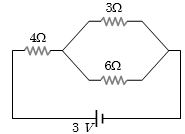
The potential drop across the $3$ $\Omega$ resistor is ............... $V$
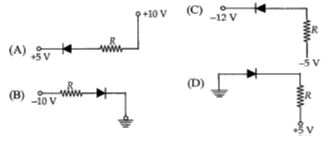
In the following figure, the diodes which are forward biased, are
Which of the following on reaction with $N{H_3}$ gives urinary antiseptic compound