MCQ
The gravitational force ${F_g}$ between two objects does not depend on
  • Sum of the masses
  • B
    Product of the masses
  • C
    Gravitational constant
  • D
    Distance between the masses

Answer

Correct option: A.
Sum of the masses
a
(a) $F_Gravitational$ $=\mathrm{F}=\left[\left(\mathrm{G} \cdot \mathrm{m}_{1} \cdot \mathrm{m}_{2}\right) / \mathrm{D}_{2}\right]$

$\mathrm{m}_{1}, \mathrm{m}_{2}$ are masses of bodies and $\mathrm{D}$ is distance between them.

$\mathrm{G}=$ Gravitational constant.

Need a full question paper?

Generate a complete, print-ready paper with questions like this in minutes — across 16+ boards, with answer keys.
Start Generating Free

Similar questions

If the earth is at one-fourth of its present distance from the sun, the duration of the year will be
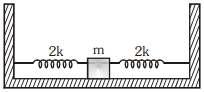
Two identical springs of spring constant $'2k'$ are attached to a block of mass $m$ and to fixed support (see figure). When the mass is displaced from equilibrium position on either side, it executes simple harmonic motion. The time period of oscillations of this sytem is ...... .
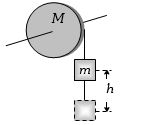
A massless string is wrapped round a disc of mass $M$ and radius $R$. Another end is tied to a mass $m$ which is initially at height $h$ from ground level as shown in the fig. If the mass is released then its velocity while touching the ground level will be
A steel wire $1.5\,m$ long and of radius $1\,mm$ is attached with a load $3\,kg$ at one end the other end of the wire is fixed it is whirled in a vertical circle with a frequency $2\,Hz$ . Find the elongation of the wire when the weight is at the lowest position $(Y = 2 \times 10^{11}\,N/m^2$ and $g = 10\,m/s^2)$
Train A is moving along two parallel rail tracks towards north with speed $72 \mathrm{~km} / \mathrm{h}$ and train B is moving towards south with speed $108 \mathrm{~km} / \mathrm{h}$. Velocity of train $B$ with respect to $A$ and velocity of ground with respect to $B$ are (in $\mathrm{ms}^{-1}$ ):
A thin paper cup filled with water does not catch fire when placed over a flame. This is because
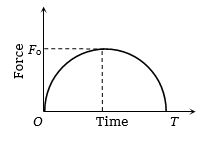
A particle of mass $m$, initially at rest, is acted upon by a variable force $F$ for a brief interval of time $T$. It begins to move with a velocity $u$ after the force stops acting. $F$ is shown in the graph as a function of time. The curve is a semicircle.
Given below are two statements: one is labelled as

Assertion $A$ and the other is labelled as Reason $R$.

Assertion $A :$ Earth has atmosphere whereas moon doesn't have any atmosphere.

Reason $R$ : The escape velocity on moon is very small as compared to that on earth.

In the light of the above statement, choose the correct answer from the options given below :
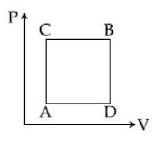
A gas can be taken from $A$ to $B$ via two different processes $ACB$ and $ADB$. When path $ACB$ is used $60\, J$ of heat flows into the system and $30\, J$ of work is done by the system. If path $ADB$ is used work down by the system is $10\, J$. the heat flow into the system in path $ADB$ is ..... $J$
Two adjacent sides of a parallelogram are represented by the two vectors $\hat i + 2\hat j + 3\hat k$ and $3\hat i - 2\hat j + \hat k$. What is the area of parallelogram