MCQ
The ground state energy of hydrogen atom is $-13.6\, eV$. The energy of second excited state of $He^+$ ion in $eV$ is
  • A
    $-54.4$
  • B
    $-3.4$
  • $-6.04$
  • D
    $-27.2$

Answer

Correct option: C.
$-6.04$
c
$E =  - 13.6\frac{{{n^2}}}{{{z^2}}}\,eV$

$E_{He}^ +  =  - 13.6\frac{4}{9}$

Need a full question paper?

Generate a complete, print-ready paper with questions like this in minutes — across 16+ boards, with answer keys.

Start Generating Free

Similar questions

${\Delta _f}{G^o}$ at $500\, K$ for substance $'S'$ in liquid state and gaseous state are $+100.7\, kcal\, mol^{-1}$ and $+103\, kcal\, mol^{-1}$ , respectively. Vapour pressure ofliquid $'S'$ at $500\, K$ is approximately equal to $(R\,= 2\,cal \,K^{-1}\,mol^{-1})$ .....$atm$
The conjugate base of ${H_2}PO_4^ - $ is
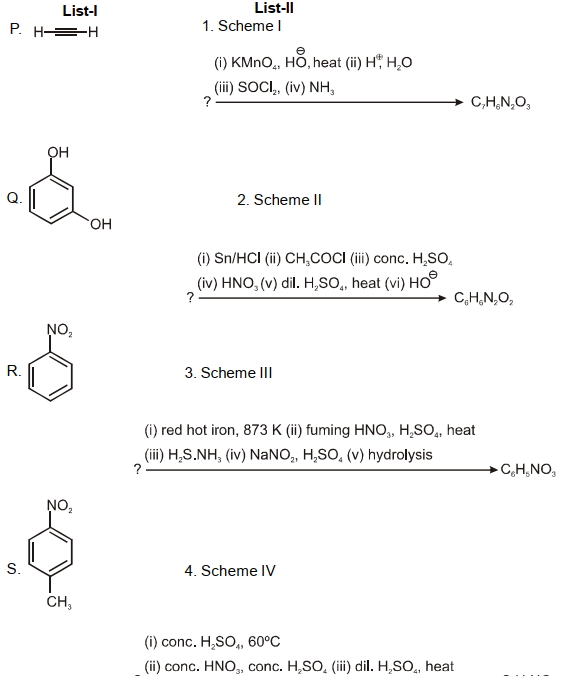
Match the four starting materials $( P , Q , R , S$ ) given in List $I$ with the corresponding reaction schemes $(I, II, III, IV)$ provided in List $II$ and select the correct answer using the code given below the lists. $Image$

Codes: $ \quad P \quad Q \quad R \quad S$
Which of the following sets of quantum numbers is not allowed
The molar solubility of $Cd(OH)_2$ is $1.84\times10^{-5}\, M$ in water. The expected solubility of $Cd(OH)_2$ in a buffer solution of $pH = 12$ is
Which of the following will produce chiral molecule after treatment with $H_2$/Lindlar's catalyst ?
Which of the following is the most electropositive element
In $Xe{O_3}$ and $Xe{F_6}$ the oxidation state of $Xe$ is
Match the transformations in column $I$ with appropriate options in column $II$
column $I$ column $II$
$(A)$ $CO _2( s ) \rightarrow CO _2( g )$ $(p)$ phase transition
$(B)$ $CaCO _3( s ) \rightarrow CaO$ (s) $+ CO _2( g )$ $(q)$ allotropic change
$(C)$ $2 H \bullet \rightarrow H _2( g )$ $(r)$ $\Delta H$ is positive
$(D)$ $P_{\text {(white, solid) }} \rightarrow P_{\text {(red, solid) }}$ $(s)$ $\Delta S$ is positive
  $(t)$ $\Delta S$ is negative
Some inert gas is added at constant volume to the following reaction at equilibrium

$N{H_4}HS(s) \rightleftharpoons N{H_3}(g) + H_2S(g)$

Predict the effect of adding the inert gas