Question
The halides of transition elements become more covalent with increasing oxidation state of the metal.

Answer

As the oxidation state increases, size of the ion of transition element decreases. As per Fajan's rule, as the size of metal ion decreases, covalent character of the bond formed increases.

Need a full question paper?

Generate a complete, print-ready paper with questions like this in minutes — across 16+ boards, with answer keys.
Start Generating Free

Similar questions

What do you understand by the term 'conductance'? What are its units?
A compound $(X)$ reacts with $PCl_5$ to form compound $Y.$ Compound $Y$ reacts with ethereal solution of magnesium to form compound $(Z),$ which on treating with propanone and further hydrolysis to give $2-$ Methyl propan$-2-ol.$ What are the compounds $X$ and $Y$ and also give the equations of the reactions.
Determine the osmotic pressure of a solution prepared by dissolving $25\ mg$ of $K_2SO_4$ in $2$ litre of water at $25^\circ C,$ assuming that it is completely dissociated.
For a reaction, the energy of activation is zero. What is the value of rate constant at $300K,$ if $k = 1.6 \times 10^6 s –^1$ at $280K$? $\ce{[R = 8.31JK–^1 mol–^1]}.$
At 300 K, 36 g of glucose present in a litre of its solution has an osmotic pressure of 4.98 bar. If the osmotic pressure of the solution is 1.52 bars at the same temperature, what would be its concentration?
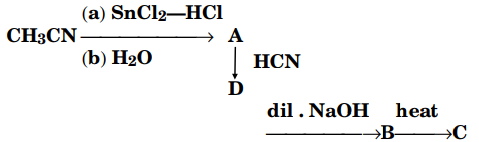
Write the structures of A, B, C and D in the following reactions :
Image
Consider a certain reaction A → Products with k = 2 × 10⁻² s-1. Calculate the concentration of A remaining after 100 s if the initial concnetration of A is 1.0 mol L-1.
Giving a suitable example for each, explain the following:
  1. Crystal field splitting.
  2. Linkage isomerism.
  3. Ambidentate ligand.
Aqueous copper sulphate solution and aqueous silver nitrate solution are electrolysed by $1$ ampere current for $10$ minutes in separate electrolytic cells. Will the mass of copper and silver deposited on the cathode be same or different? Explain your answer.
Discuss in details the oxidation of methyl ketones by haloform reaction. And also mention that for detection of which type of group this reaction is useful?