Question
Write the structures of A, B, C and D in the following reactions :
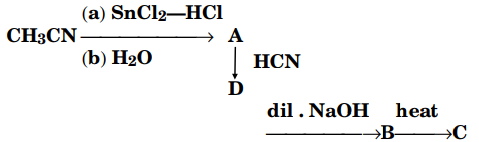
Image

Answer

Get the step-by-step solution for this question inside the Vidyadip app.

Get the answer in the app

Need a full question paper?

Generate a complete, print-ready paper with questions like this in minutes — across 16+ boards, with answer keys.

Start Generating Free

Similar questions

Match the properties given in Column I with the metals given in Column II.
 
Column I (Property)
 
Column II (Metal)
(i)
An element which can show +8 oxidation state
(a)
Mn
(ii)
3d block element that can show upto +7 oxidation state
(b)
Cr
(iii)
3d block element with highest melting point
(c)
Os
   
(d)
Fe
 
The monoamino monocarboxylic acids have two $\ce{pK_a}$ values.
How would you account for the following situations?
  1. The transition metals generally form coloured compounds.
  2. With $3d^4 $ configuration, $\ce{Cr^{2+}}$ acts as a reducing agent but $\ce{Mn^{3+}}$ acts as an oxidising agent. $($Atomic Numbers, $\ce{Cr = 24, Mn = 25)}.$
  3. The actinoids exhibit a larger number of oxidation states than the corresponding lanthanoids.
$a.$ Write the formulation for the galvanic cell in which the reaction $\ce{Cu(s) + 2Ag^{+}(aq) \rightarrow Cu^{2+}(a q) + 2Ag(s)}$ takes place.
Identify the cathode and the anode reactions in it.
$b.$ Write Nernst equation and calculate the emf of the following cell: $Sn ( s )\left| Sn ^{2+}(0.04 M ) \| H ^{+}(0.02 M )\right| H _2(g) \mid \operatorname{Pt}( s )$
$\left(\right.$ Given $\left.\ce{E_{S n^{2+} / S n}}=-0.14 V\right)$
The cell in which the following reaction occurs:
$2\text{Fe}^{3+}(\text{aq})+2\text{I}^-(\text{aq})\rightarrow2\text{Fe}^{2+}(\text{aq})+\text{I}_2(\text{s})\ \text{has}\ \text{E}^\circ_{\text{cell}}= 0.236\ V$  at $298\ K.$ Calculate the standard Gibbs energy and the equilibrium constant of the cell reaction.
Calculate the emf of the following cell at $25^oC:$
$Ag(s)|Ag^+(10^{-3}M)||Cu^{2+}(10^{-1}M)|Cu(S).$
Given $E^o_{cell}=+0.46 V and \log 10^n=n.$
  1. Write the name of two monosaccharides obtained on hydrolysis of lactose sugar.
  2. Why Vitamin C cannot be stored in our body?
  3. What is the difference between a nucleoside and nucleotide?
Calculate e.m.f of the following cell at $298 K:$
$2Cr(s)+3Fe^{2+}(0.1M) \rightarrow 2Cr^{3+}(0.01M)+3Fe(s)$
Given: $E^\circ (Cr^{3+}|Cr)= –0.74 V E^\circ (Fe^{2+}|Fe) = –0.44 V$
Write the isomers of the compound having formula $C _4 H _9 Br$.
Explain the difference between instantaneous rate of a reaction and average rate of a reaction.