MCQ
The harmonics which are present in a pipe open at one end are
  • Odd harmonics
  • B
    Even harmonics
  • C
    Even as well as odd harmonics
  • D
    None of these

Answer

Correct option: A.
Odd harmonics
a
(a)In closed pipe only odd harmonics are present

Need a full question paper?

Generate a complete, print-ready paper with questions like this in minutes — across 16+ boards, with answer keys.
Start Generating Free

Similar questions

A body sliding on a smooth inclined plane requires $4$ seconds to reach the bottom starting from rest at the top. How much time does it take to cover one-fourth distance starting from rest at the top.............$s$
A fish looking up through the water sees the outside world contained in a circular horizon. If the refractive index of water is $\frac{4}{3}$ and the fish is $12 cm$ below the surface, the radius of this circle in cm is
The plates of a capacitor are charged to a potential difference of $320 \, volts$ and are then connected across a resistor. The potential difference across the capacitor decays exponentially with time. After $1 $ second the potential difference between the plates of the capacitor is $240 \, volts$, then after $2$ and $3$ seconds the potential difference between the plates will be
The position, velocity and acceleration of a particle executing simple harmonic motion are found to have magnitudes of $4 \mathrm{~m}, 2 \mathrm{~ms}^{-1}$ and $16 \mathrm{~ms}^{-2}$ at a certain instant. The amplitude of the motion is $\sqrt{\mathrm{x}} \mathrm{m}$ where $\mathrm{x}$ is. . . . . . . 
A $25\, watt$, $220\, volt$ bulb and a $100\, watt$,  $220\, volt$ bulb are connected in parallel across a $220\, volt$ line. Which bulb will glow more brightly
To avoid slipping while walking on ice, one should take smaller steps because of the
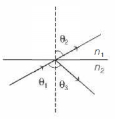
A monochromatic beam of light is incident at the interface of two materials of refractive index $n_{1}$ and $n_{2}$ as shown. If $n_{1} >n_{2}$ and $\theta_{C}$ is the critical angle, then which of the following statements is NOT true?
Water flows into a cylindrical vessel of large cross-sectional area at a rate of $10^{-4}$ $m^3/s$. It flows out from a hole of area $10^{-4}$ $m^2$, which has been punched through the base. How high does the water rise in the vessel?
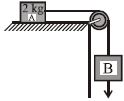
The coefficient of static friction, $\mu _s$ between block $A$ of mass $2\,kg$ and the table as shown in the figure is $0.2$. What would be the maximum mass value of block $B$ so that the two blocks $B$ so that the two blocks do not move? The string and the pulley are assumed to be smooth and masseless ....... $kg$ $(g = 10\,m/s^2)$
$AC$ voltage $V(t)=20\,sin\omega \,t$ of frequency $50\, {Hz}$ is applied to a parallel plate capacitor. The separation between the plates is $2\, {mm}$ and the area is $1 \,{m}^{2}$. The amplitude of the oscillating displacement current for the applied $AC$ voltage is ...... $\mu {A}$.

[Take $\left.\varepsilon_{0}=8.85 \times 10^{-12} \,{F} / {m}\right]$