MCQ
The heart of a man pumps $5$ litres of blood through the arteries per minute at a pressure of $150 \,mm$ of mercury. If the density of mercury be $13.6 \times 10^3\, kg/m^3$ and $g=10\,m/s^2$ then the power (in watt) is 
  • A
    $1.5$
  • B
    $3$
  • C
    $2.35$
  • $1.7$

Answer

Correct option: D.
$1.7$
d
$\begin{array}{l}
\,\,\,\,\,\,\,\,\,\,\,Here,\,volume\,of\,blood\,pumped\\
by\,man's\,heart\\
V = 5\,litres\, = 5 \times {10^{ - 3}}\,{m^3}\,\,\left( {1\,lite = {{10}^{ - 3}}\,{m^3}} \right)\\
Time\,in\,which\,this\,volume\,of\,blood\,\\
pumps,\,\\
t = 1\,\min \, = 60\,s\\
pressure\,at\,which\,the\,blood\,pumps,\\
p = 150\,mm\,of\,Hg\, = 0.15\,m\,of\,Hg\\
\,\,\, = \,\left( {0.15\,m} \right)\left( {13.6 \times {{10}^3}\,kg/{m^3}} \right)\left( {10\,m/{s^2}} \right)
\end{array}$

$\begin{array}{l}
\,\,\,\,\,\,\,\,\,\,\,\,\,\,\,\,\,\,\,\,\,\,\,\,\,\,\,\,\,\,\,\,\,\,\,\,\,\,\,\,\,\,\,\,\,\,\,\,\,\,\,\,\,\left( {p = h\rho g} \right)\\
\,\,\, = 20.4 \times {10^3}\,N/{m^2}\\
\therefore \,\,power\,of\,the\,heart = \frac{{PV}}{t}\\
 = \frac{{\left( {20.4 \times {{10}^3}\,N/{m^2}} \right)\left( {5 \times {{10}^{ - 3}}{m^{ - 3}}} \right)}}{{60\,s}}\\
 = 1.70\,W
\end{array}$
Need a full question paper?

Generate a complete, print-ready paper with questions like this in minutes — across 16+ boards, with answer keys.

Start Generating Free

Similar questions

A uniform rod of length $L$ has a mass per unit length $\lambda$ and area of cross-section $A$. If the Young's modulus of the rod is $Y$. Then elongation in the rod due to its own weight is ...........
A thin hollow cylinder open at both ends:

$(i)$ Slides without rotating

$(ii)$ Rolls without slipping, with the same speed

 A steel wire is stretched with a definite load. If the Young's modulus of the wire is $Y$. For decreasing the value of $Y$
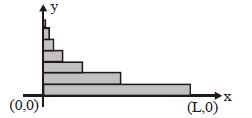
Infinite rods of uniform mass density and length $L, L/2, L/4....$ are placed one upon another upto infinite as shown in figure. Find the $x-$ coordinate of centre of mass
A man standing on the roof of a house of height $h$ throws one particle vertically downwards and another particle horizontally with the same velocity $u$. The ratio of their velocities when they reach the earth's surface will be
A solid sphere, disc and solid cylinder all of the same mass and made of the same material are allowed to roll down (from rest) on the inclined plane, then ....
Two whistles $A$ and $B$ each have a frequency of $500\,\,Hz$. $A$ is stationary and $B$ is moving towards the right (away from $A$) at a speed of $50\,\, m/s$. An observer is between the two whistles moving towards the right with a speed of $25\,\, m/s.$ The velocity of sound in air is $350 \,\,m/s$. Assume there is no wind. Then which of the following statements are true:
A cylinder of height 20m is completely filled with water. The velocity of efflux of water (in ms) through a small hole on the side wall of the cylinder near its bottom is:
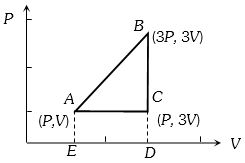
An ideal gas is taken around $ABCA$ as shown in the above $P-V$ diagram. The work done during a cycle is
A boy is walking away from a wall towards an observer at a speed of $1\, metre/sec$ and blows a whistle whose frequency is $680 Hz.$ The number of beats heard by the observer per second is (Velocity of sound in air $= 340\, metres/sec$)