Question
The heat current is written as $\frac{\triangle\text{Q}}{\triangle\text{t}}.$ Why don't we write $\frac{\text{dQ}}{\text{dt}}?$

Answer

The amount of heat crossing through any cross-section of a slab in time $\triangle\text{t}$ is called heat current.
It is written as $\frac{\triangle\text{Q}}{\triangle\text{t}}$ and not as complete derivative $\frac{\text{dQ}}{\text{dt}}.$
This is because the amount of heat crossing through any cross section is a function of many variables like temperature difference, area of cross-section, etc.
So, we cannot write it as a complete derivative with respect to time.

Need a full question paper?

Generate a complete, print-ready paper with questions like this in minutes — across 16+ boards, with answer keys.
Start Generating Free

Similar questions

The sap in trees, which consists mainly of water in summer, rises in a system of capillaries of radius $\mathrm{r}=2.5 \times 10^{-5} \mathrm{~m}$. The surface tension of sap is $\mathrm{T}=7.28 \times 10^{-2} \mathrm{~N} \mathrm{~m}^{-1}$ and the angle of contact is $0^{\circ}$. Does surface tension alone account for the supply of water to the top of all trees?
A uniform disc of mass m and radius r is suspended through a wire attached to its centre. If the time period of the torsional oscillations be T, what is the torsional constant of the wire.
A straight horizontal wire of mass 10mg and length 1.0m carries a current of 2.0A. What minimum magnetic field B should be applied in the region, so that the magnetic force on the wire may balance its weight?
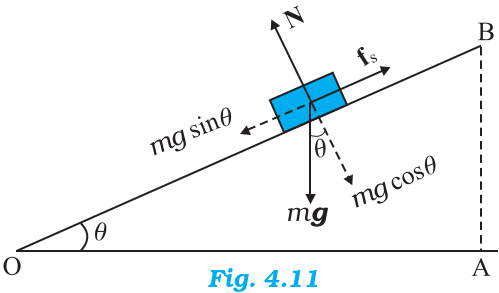
See Fig. 4.11. A mass of 4 kg rests on a horizontal plane. The plane is gradually inclined until at an angle θ = 15° with the horizontal, the mass just begins to slide. What is the coefficient of static friction between the block and the surface ?
Image
An ideal gas $\Big(\frac{\text{C}_\text{P}}{\text{C}_\text{V}}=\gamma\Big)$ is taken through a process in which the pressure and the volume vary as $p = aV^b$. Find the value of b for which the specific heat capacity in the process is zero.
A cricket bowler releases the ball in two different ways.
  1. Giving it only horizontal velocity, and
  2. Giving it horizontal velocity and a small downward velocity. The speed $v_s$ at the time of release is the same. Both are released at a height H from the ground. Which one will have greater speed when the ball hits the ground? Neglect air resistance.
Two particles of masses $m_1$ and $m_2$ are joined by a light rigid rod of length r. The system rotates at an angular speed co about an axis through the centre of mass of the system and perpendicular to the rod. Show that the angular momentum of the system is $\text{L}=\mu\text{r}^2\omega$ where $\mu$ is the reduced mass of the system defined as $\mu=\frac{\text{m}_1\text{m}_2}{\text{m}_1+\text{m}_2}.$
Explain that torque is only due to transverse component of force. Radial component has nothing to do with torque.
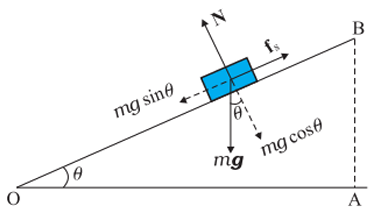
A mass of 4 kg rests on a horizontal plane. The plane is gradually inclined until at an angle $\theta=15^{\circ}$ with the horizontal, the mass just begins to slide. What is the coefficient of static friction between the block and the surface?
Image
A body of mass 2kg is at rest at a height of 10m above the ground. Calculate its potential energy and kinetic energy after it has fallen through half the height. Also find the velocity at this instant.