Question
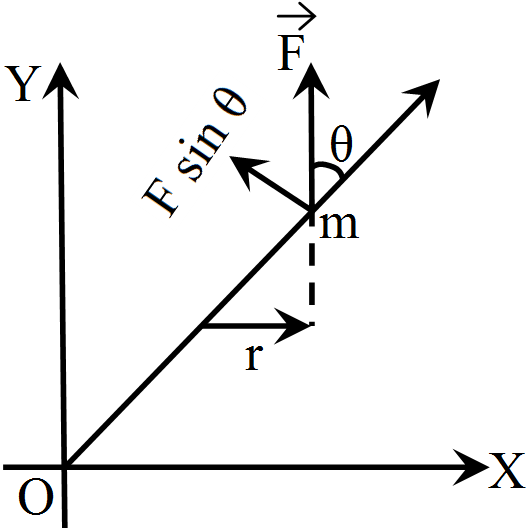
Explain that torque is only due to transverse component of force. Radial component has nothing to do with torque.
Answer

Torque is defined as the moment of force. $\tau=\vec{\text{r}}\times\vec{\text{F}}=\text{r}\text{ F}\sin\theta\ \hat{\text{n}}.\hat{\text{n}}$ is along axis of rotation. If a force $\vec{\text{F}}$ acts at an angle $\theta$ to the position vector i then $\text{F}\sin\theta$ acts perpendicularly to the position- vector. Therefor $\tau=\text{r}_{\bot}\text{F}$ and so the radial component does not bring any influence on the torque.

Need a full question paper?

Generate a complete, print-ready paper with questions like this in minutes — across 16+ boards, with answer keys.
Start Generating Free

Similar questions

The wheel of a car is rotating at a speed of 20 revolutions/second. If due to acceleration its rotation speed becomes 75 revolutions/second in 10 seconds, then find the angular acceleration and angular displacement after this time
The magnetic field at a point inside a 2.0mH inductor coil becomes 0.80 of its maximum value in 20µs when the inductor is joined to a battery. Find the resistance of the circuit.
A body falls towards earth in air. Will its total mechanical energy be conserved during the fall? Justify
A horizontal platform with an object placed on it is executing SHM in the vertical direction. The amplitude of oscillation is $2.5cm$. What must be the least period of these oscillations so that the object is not detached from the platform? Take $g = 10ms^{-2}$?
A particle is subjected to two simple harmonic motions of same time period in the same direction. The amplitude of the first motion is $3.0\ cm$ and that of the second is $4.0\ cm.$ Find the resultant amplitude if the phase difference between the motions is:
  1. $0^\circ$
  2. $60^\circ$
  3. $90^\circ$
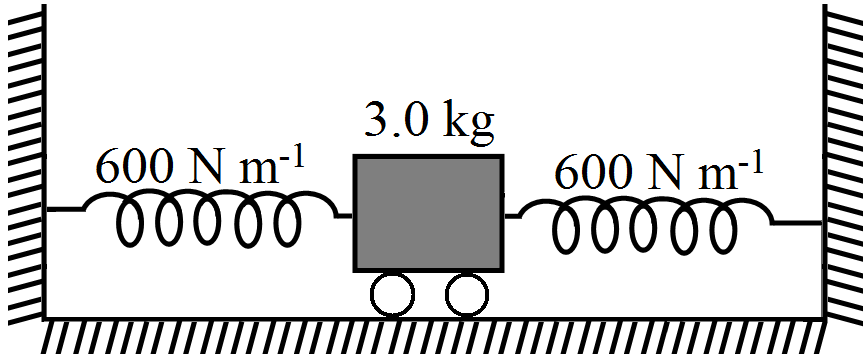
A trolley of mass $3.0\ kg$, as shown in Figure, is connected to two springs, each of spring constant $600Nm^{-1}$. If the trolley is displaced from its equilibrium position by $5.0\ cm$ and released, what is $(a)$ the period of ensuing oscillations, and $(b)$ the maximum speed of the trolley? How much energy is dissipated as heat by the time trolley comes to rest due damping forces?
The magnetic field in a plane electromagnetic wave is given by $\text{B}=(200\mu\text{T})\sin\Big[\big(4.0\times10^{15}\text{s}^{-1}\big)\Big(\text{t}-\frac{\text{x}}{\text{c}}\Big)\Big]$ Find the maximum electric field and the average energy density corresponding to the electric field.
The radius of curvature of a concave mirror measured by spherometer is given by $\text{R}=\frac{\text{I}^2}{6\text{h}}+\frac{\text{h}}{2}.$ The values of land h are 4cm and 0.065cm respectively. Compute the error in measurement of radius of curvature.
If the earth has a mass $9$ times and radius twice of the planet Mars, calculate the minimum speed required by a rocket to pull out of the gravitational force of Mars. Escape speed on the surface of the earth is $11.2km s^{-1}$.
The diameter of a wire as measured by a screw gauge was found to be $1.328, 1.330, 1.325, 1.334$ and $1.336\ cm$. Calculate
  1. Mean value of diameter.
  2. Absolute error in each measurement.
  3. Mean absolute error.
  4. Fractional error.
  5. Percentage error.
  6. Diameter of wire.