The heat radiated per unit area in $1\,hour$ by a furnace whose temperature is $3000\,K$ is $( \sigma = 5. 7 \times 10^{-8}\,W\,m^{-2}\,K^{-4})$
AIEEE 2012, Medium


Download our appand get started for free
Experience the future of education. Simply download our apps or reach out to us for more information. Let's shape the future of learning together!No signup needed.*
Similar Questions
- 1One end of a copper rod of length $1.0\;m$ and area of cross-section ${10^{ - 3}}$ is immersed in boiling water and the other end in ice. If the coefficient of thermal conductivity of copper is $92\;cal/m{\rm{ - }}s{{\rm{ - }}^o}C$ and the latent heat of ice is $8 \times {10^4}cal/kg$, then the amount of ice which will melt in one minute isView Solution
- 2One end of a copper rod of length $1.0\;m$ and area of cross-section ${10^{ - 3}}$ is immersed in boiling water and the other end in ice. If the coefficient of thermal conductivity of copper is $92\;cal/m{\rm{ - }}s{{\rm{ - }}^o}C$ and the latent heat of ice is $8 \times {10^4}cal/kg$, then the amount of ice which will melt in one minute isView Solution
- 3Two walls of thicknesses $d_1$ and $d_2$ and thermal conductivities $k_1$ and $k_2$ are in contact. In the steady state, if the temperatures at the outer surfaces are ${T_1}$ and ${T_2}$, the temperature at the common wall isView Solution
- 4View SolutionWhen fluids are heated from the bottom, convection currents are produced because
- 5View SolutionWhen red glass is heated in dark room it will seem
- 6View SolutionFor cooking the food, which of the following type of utensil is most suitable
- 7Two bottles $A$ and $B$ have radii $R_{A}$ and $R_{B}$ and heights $h_{A}$ and $h_{B}$ respectively, with $R_{B}=2 R_{A}$ and $h_{B}=2 h_{A}$. These are filled with hot water at $60^{\circ} C$. Consider that heat loss for the bottles takes place only from side surfaces. If the time, the water takes to cool down to $50^{\circ} C$ is $t_{A}$ and $t_{B}$ for bottles $A$ and $B$, respectively. Then, $t_{A}$ and $t_{B}$ are best related asView Solution
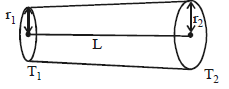
- 8The rate of heat flow through the cross-section of the rod shown in figure is ($T_2 > T_1$ and thermal conductivity of the material of the rod is $K$)View Solution
- 9Three rods of Copper, Brass and Steel are welded together to form a $Y$ shaped structure. Area of cross - section of each rod $= 4\ cm^2$ . End of copper rod is maintained at $100^o C $ where as ends ofbrass and steel are kept at $0^o C$. Lengths of the copper, brass and steel rods are $46, 13$ and $12\ cms$ respectively. The rods are thermally insulated from surroundings excepts at ends. Thermal conductivities of copper, brass and steel are $0.92, 0.26$ and $0.12\ CGS$ units respectively. Rate ofheat flow through copper rod is ....... $cal\, s^{-1}$View Solution
- 10According to Newton’s law of cooling, the rate of cooling of a body is proportional to ${(\Delta \theta )^n}$, where $\Delta \theta $ is the difference of the temperature of the body and the surroundings, and n is equal toView Solution