Question
The height y and the distance x along the horizontal plane of a projectile on a certain plane (with no atmosphere) are given by $x = (6t)$ metre; $y = (8t - 5r^2)$ metre. where t is in seconds. What is the velocity with which the projectile is projected?
Answer

$\text{x}=6\text{t}$$\therefore\ \frac{\text{dx}}{\text{dt}}=6\dots(\text{i})$
$\text{y}=8\text{t}-5\text{t}^2$
$\therefore\ \frac{\text{dy}}{\text{dt}}=8-10\text{t}\dots(\text{ii})$
Velocity with which it is projected can be written as:
$\text{v}^2=\Big(\frac{\text{dx}}{\text{dt}}\Big)^2+\Big(\frac{\text{dy}}{\text{dt}}\Big)^2$
Putting, t = 0 in equations (i) and (ii);
$\Big(\frac{\text{dy}}{\text{dt}}\Big)_{\text{t}=0}=8;\Big(\frac{\text{dx}}{\text{dt}}\Big)_{\text{t}=0}=6$
$\therefore\ \text{v}^2=6^2+8^2=36+64,\ \text{v}=10\text{m/s}$

Need a full question paper?

Generate a complete, print-ready paper with questions like this in minutes — across 16+ boards, with answer keys.

Start Generating Free

Similar questions

A pipe $20cm$ long is closed at one end. Which harmonic mode of the pipe is resonantly excited by a $430Hz$ source? Will the same source be in resonance with the pipe if both ends are open? (speed of sound in air is $340m s^{–1}$).
The two square faces of a rectangular dielectric slab (dielectric constant 4.0) of dimensions 20cm × 20cm × 1.0mm are metal-coated. Find the capacitance between the coated surfaces.
Match the technology in column A to its related scientific principle(s) in column B.
S. No
A. Technology
S. No
B. Scientific principle(s)
1.
Steam engine
(i)
Propagation of electromagnetic waves
2.
Nuclear reactor
(ii)
Newton's laws of motion
3.
Radio and television
(iii)
Superconductivity
4.
Computers
(iv)
Role of DNA in heredity
5.
Lasers
(v)
Thermodynamics
6.
Production of ultra high magnetic fields
(vi)
Faraday's law of induction
7.
Rocket propulsion
(vii)
Conversion of gravitational potential energy into electrical energy
8.
Genetic engineering
(viii)
Motion of charged particles in electromagnetic fields.
9.
Electric generator
(ix)
Fission of uranium by slow neutrons
10.
Hydroelectric power
(x)
Amplification by population inversion
11.
Aeroplane
(xi)
Digital logic of electronic circuits
12.
Particle accelerators
(xii)
Bernoulli's principle in fluid dynamics
Considering the pressure p to be proportional to the density, find the pressure p at a height h if the pressure on the surface of the earth is $p_0$.
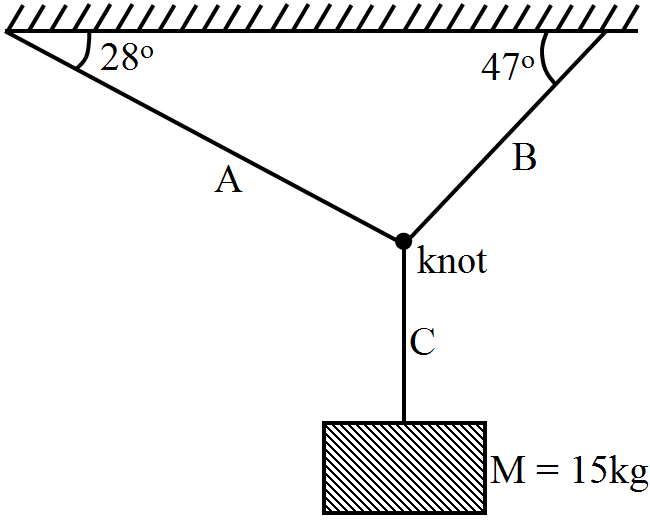
A block of mass $15kg$ hangs from three chords as shown in figure. What are the tensions in the chords?
A pump on the ground floor of a building can pump up water to fill a tank of volume $30m^3$ in $15min$. If the tank is $40m$ above the ground, and the efficiency of the pump is $30\%$, how much electric power is consumed by the pump?
a. Find the moment of inertia of a sphere about a tangent to the sphere, given the moment of inertia of the sphere about any of its diameters to be $\frac{2 M R^2}{5}$, where $M$ is the mass of the sphere and $R$ is the radius of the sphere.
b. Given the moment of inertia of a disc of mass M and radius R about any of its diameters to be $\frac{M R^2}{4}$, find its moment of inertia about an axis normal to the disc and passing through a point on its edge.
Draw a graph to show the variation of P.E., K.E. and total energy of a simple harmonic oscillator with displacement.
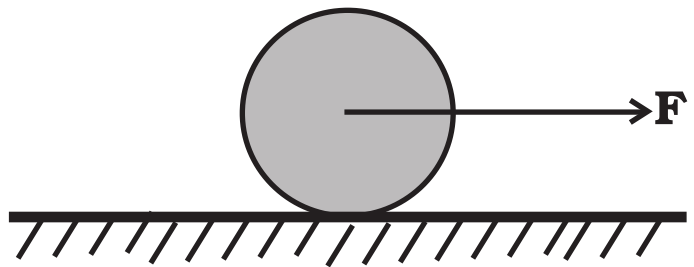
A uniform disc of radius R, is resting on a table on its rim.The coefficient of friction between disc and table is $\mu.$Now the disc is pulled with a force F as shown in the figure. What is the maximum value of F for which the disc rolls without slipping?
Which of the following functions of time represent (a) periodic and (b) non-periodic motion? Give the period for each case of periodic motion [ $\omega$ is any positive constant].
(i) $\sin \omega t+\cos \omega t$
(ii) $\sin \omega t+\cos 2 \omega t+\sin 4 \omega t$
(iii) $e ^{-\omega t}$
(iv) $\log (\omega t)$