A uniform disc of radius R, is resting on a table on its rim.The coefficient of friction between disc and table is $\mu.$Now the disc is pulled with a force F as shown in the figure. What is the maximum value of F for which the disc rolls without slipping?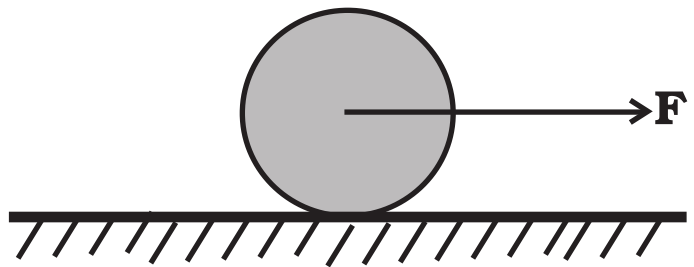
Download our app for free and get started
Let 'a', $\alpha$ be the linear and angular acceleration respectively. For linear motion, F - f = Ma ....(i)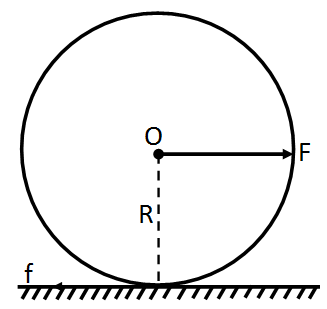
Where M is mass of disc. Force of friction (f) applies torque about centre O. But torque due to F is along 'O'. $\therefore$ Torque to disc $\tau=\text{I}_\text{D}\alpha$ $\because$ M.I. of disc is $\text{I}_\text{D}=\frac{1}{2}\text{MR}^2$ $\text{f.R}=\frac{1}{2}\text{MR}^2\cdot\frac{\text{a}}{\text{R}}\ \because\ \text{a}=\text{Ra}$ $\text{f.R}=\frac{1}{2}\text{MRa}$ $\text{Ma}=2\text{f}\ ....(\text{ii})$ $\text{F}-\text{f}=2\text{f}$ $3\text{f}=\text{F}$ Or $\text{f}=\frac{\text{F}}{3}\ \because\ \text{N}=\text{Mg}$ $\mu.\text{M}=\frac{\text{F}}{3}$ $\text{F}=3\mu\text{ Mg}$ is the maximum force applied on disc to roll on surface without slipping.
Where M is mass of disc. Force of friction (f) applies torque about centre O. But torque due to F is along 'O'. $\therefore$ Torque to disc $\tau=\text{I}_\text{D}\alpha$ $\because$ M.I. of disc is $\text{I}_\text{D}=\frac{1}{2}\text{MR}^2$ $\text{f.R}=\frac{1}{2}\text{MR}^2\cdot\frac{\text{a}}{\text{R}}\ \because\ \text{a}=\text{Ra}$ $\text{f.R}=\frac{1}{2}\text{MRa}$ $\text{Ma}=2\text{f}\ ....(\text{ii})$ $\text{F}-\text{f}=2\text{f}$ $3\text{f}=\text{F}$ Or $\text{f}=\frac{\text{F}}{3}\ \because\ \text{N}=\text{Mg}$ $\mu.\text{M}=\frac{\text{F}}{3}$ $\text{F}=3\mu\text{ Mg}$ is the maximum force applied on disc to roll on surface without slipping.

Download our appand get started for free
Experience the future of education. Simply download our apps or reach out to us for more information. Let's shape the future of learning together!No signup needed.*
Similar Questions
- 1A cylinder of mass $5kg$ and radius $30cm$ and free to rotate about its axis, receives an angular impulse of $3kgm^2 s^{-1}$ followed by a similar impulse after every $4$ seconds. What is the angular speed of the cylinder $30s$ after the initial impulse? The cylinder is at rest initially.View Solution
- 2An electron of mass $9 \times 10^{-31}kg$ revolves in a circle of radius $0.53\mathring{\text{A}}$ around the nucleus of hydrogen with a velocity of $2.2 \times 10^6ms$. Show that angular momentum of elect ron is $\frac{\text{h}}{2\pi}$ where h is Planck's constant.View Solution
- 3From a uniform disk of radius R, a circular hole of radius $\frac{\text{R}}{2}$ is cut out. The centre of the hole is at $\frac{\text{R}}{2}$ from the centre of the original disc. Locate the centre of gravity of the resulting flat body.View Solution
- 4Separation of Motion of a system of particles into motion of the centre of mass and motion about the centre of mass: Show $\text{K}=\text{K}'+\frac{1}{2}\text{M}\text{V}^2$ where K' is the total kinetic energy of the system of particles, K′ is the total kinetic energy of the system when the particle velocities are taken with respect to the centre of mass and $\frac{\text{MV}^2}{2}$ is the kinetic energy of the translation of the system as a whole (i.e. of the centre of mass motion of the system). The result has been used in $\sec7.14$View Solution
- 5A beam of uniform cross-section and uniform mass-density of mass $20kg$ is supported at ends. A mass of $5kg$ is placed at a distance of $\frac{\text{L}}{5\text{m}} $ from one of its end. If beam is L m long, what are reactions of supports? In dealing with problems of equilibrium of a rigid body (like beam in this question). first of all draw a free body diagram of the system, indicating all of the forces acting on the system.View Solution
- 6Separation of Motion of a system of particles into motion of the centre of mass and motion about the centre of mass: Show $\text{p}=\text{p}'_\text{i}+\text{m}_\text{i}\text{V}$ where $p_i$ is the momentum of the ith particle (of mass $m_i$ ) and $p′_i = m_iv′_i$. Note: $v′_i$ is the velocity of the ith particle relative to the centre of mass. Also, prove using the definition of the centre of mass.View Solution
- 7A uniform sphere of mass m and radius R is placed on a rough horizontal surface. The sphere is struck horizontally at a height h from the floor. Match the following:View Solution
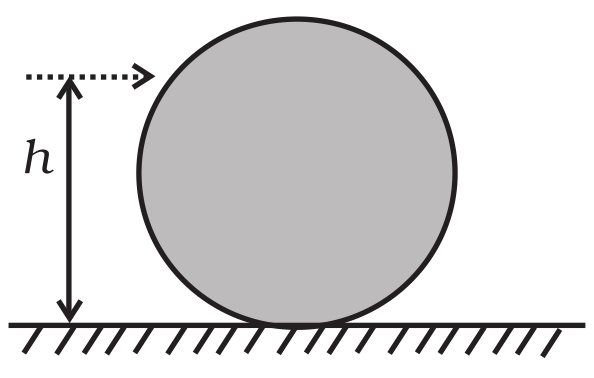
a. $\text{h}=\frac{\text{R}}{2}$ i. Sphere rolls without slipping with a constant velocity and no loss of energy. b. $\text{h}=\text{R}$ ii. Sphere spins clockwise, loses energy by friction. c. $\text{h}=\frac{3\text{R}}{2}$ iii. Sphere spins anti-clockwise, loses energy by friction. d. $\text{h}=\frac{7\text{R}}{5}$ iv. Sphere has only a translational motion, looses energy by friction. - 8View SolutionA uniform disc of radius R and mass M is mounted on an axis supported in fixed frictionless bearing. A light chord is wrapped around the rim of the wheel and suppose that we hang a body of mass m from the chord. Find the angular acceleration of the disc and tangential acceleration of point on the rim.
- 9View SolutionSuppose the particle of the previous problem has a mass m and a speed v before the collision and it sticks to the rod after the collision. The rod has a mass M:
- Find the velocity of the centre of mass C of the system constituting ''The rod plus the particle''.
- Find the velocity of the particle with respect to C before the collision.
- Find the velocity of the rod with respect to C before the collision.
- Find the angular momentum of the particle and of the rod about the centre of mass C before the collision.
- Find the moment of inertia of the system about the vertical axis through the centre of mass C after the collision.
- Find the velocity of the centre of mass C and the angular velocity of the system about the centre of mass after the collision.
- 10The moment of inertia of a solid flywheel about its axis is $0.1kg-m^2$. A tangential force of $2kg/ wt$ is applied round the circumference of the flywheel with the help of a string and mass arrangement as shown in Fig. If the radius of the wheel is $0.1m$, find the acceleration of the mass.View Solution