MCQ
The helical structure of protein is stabilized by
  • A
    Ether bonds
  • B
    Peptide bonds
  • C
    Dipeptide bonds
  • Hydrogen bonds

Answer

Correct option: D.
Hydrogen bonds
d
(d) $\alpha$ -helix structure is formed when the chain of $\alpha$ -amino acid coil as a right handed screw because of the formation of hydrogen bonds between amide groups of the same peptide chain i.e., $NH$ group in one unit is linked to carbonyl oxygen of the third unit by hydrogen bonding. This $H-$ bonding is responsible for holding helix in a position.

Need a full question paper?

Generate a complete, print-ready paper with questions like this in minutes — across 16+ boards, with answer keys.
Start Generating Free

Similar questions

Ethanol can be prepared more easily by which reaction ?
$(i)\, CH_3CH_2Br + H_2O \longrightarrow CH_3CH_2OH$
$(ii)\, CH_3CH_2Br + Ag_2O\, (in\, boiling\, water) \longrightarrow CH_3CH_2OH$
The electronic configuration of Gadolinium is 
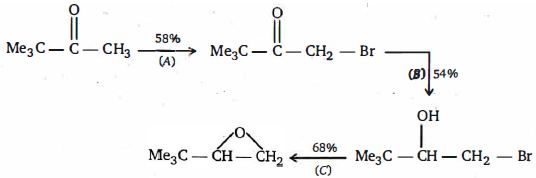
Yield of each step as actually carried out in the laboratory is given above. .......... $\%$ is  overall yield of reaction .
If the standard electrode potential for a cell is $2\,V$ at $300\,K,$ the equilibrium constant $(K)$ for the reaction

$Zn\,(s)\,\, + \,\,C{u^{2 + }}\,(aq)\, \rightleftharpoons \,Z{n^{2 + \,}}\,(aq)\, + Cu\,(s)$

At $300\,K$ is approximately $(R = 8 \,JK^{-1}\,mol^{-1},\, F = 96000\,C\,mol^{-1})$

Standard reduction potentials of the half reactions are given below :

$F_{2(g)} + 2e^- \rightarrow 2F^-_{(aq)}\, ;$  $E^o = + 2.85\, V$

$Cl_{2(g)} + 2e^- \rightarrow 2Cl^-_{(aq)}\, ;$   $E^o = + 1.36\, V$

$Br_{2(l)} + 2e^- \rightarrow 2Br^-_{(aq)}\, ;$  $E^o = + 1.06\, V$

$I_{2(s)} + 2e^- \rightarrow 2I^-_{(aq)}\, ;$  $E^o = + 0.53\, V$

The strongest oxidising and reducing agents respectively are
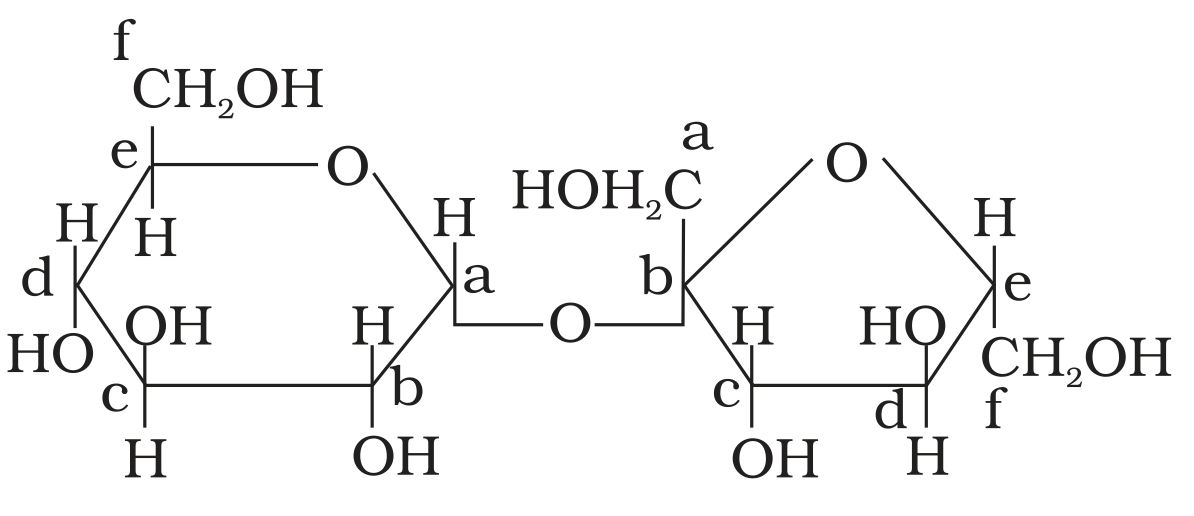
Structure of a disaccharide formed by glucose and fructose is given below. Identify anomeric carbon atoms in monosaccharide units.
Which one the following compounds will readily react with dilute $\mathrm{NaOH}$ ?
Zinc displaces copper from the solution of its salt because
Toluene is oxidised to benzoic acid by
A current $I$ is passed for a time $t$ through a number of voltameters. If m is the mass of a substance deposited on an electrode and $z$ is its electrochemical equivalent, then