MCQ
The horizontal range and maximum height attained by a projectile are $R$ and $H$, respectively. If a constant horizontal acceleration $a=g / 4$ is imparted to the projectile due to wind, then its horizontal range and maximum height will be
  • A
    $(R+H), \frac{H}{2}$
  • B
    $\left(R+\frac{H}{2}\right), 2 H$
  • C
    $( R +2 H ), H$
  • $(R+H), H$

Answer

Correct option: D.
$(R+H), H$
d
(d)

$H=H$ (as vertical component of acceleration has not changed)

$R^{\prime} =u_x T+\frac{1}{2} a_x T^2$

$=R+\frac{1}{2} \times \frac{g}{4} \times \frac{4 u^2 \sin ^2 \theta}{g^2}$

$=R \frac{u^2 \sin ^2 \theta}{2 g}=(R+H)$

Need a full question paper?

Generate a complete, print-ready paper with questions like this in minutes — across 16+ boards, with answer keys.

Start Generating Free

Similar questions

A sphere is rotating about a diameter
If the mass of earth is $80$ times of that of a planet and diameter is double that of planet and $‘g’$ on earth is $9.8\,m/{s^2}$, then the value of $‘g’ $ on that planet is ........ $m/{s^2}$
A particle moves along a circle of radius $\left( {\frac{{20}}{\pi }} \right)\,m$ with constant tangential acceleration. If the velocity of the particle is $80 \,m/s$ at the end of the second revolution after motion has begin, the tangential acceleration is
Weight of a body of mass m decreases by $1\%$ when it is raised to height $h$ above the earth’s surface. If the body is taken to a depth h in a mine, change in its weight is
A hot body, obeying Newton's law of cooling is cooling down from its peak value $80\,^oC$ to an ambient temperature of $30\,^oC$ . It takes $5\, minutes$ in cooling down from $80\,^oC$ to $40\,^oC$.  ........  $\min.$ will it take to cool down from $62\,^oC$ to $32\,^oC$ ? (Given $ln\, 2\, = 0.693, ln\, 5\, = 1.609$)
Two forces of magnitude $F$ have a resultant of the same magnitude $F$. The angle between the two forces is ........ $^o$
The mass and length of a wire are $M$ and $L$ respectively. The density of the material of the wire is $d$. On applying the force $F$ on the wire, the increase in length is $l$, then the Young's modulus of the material of the wire will be
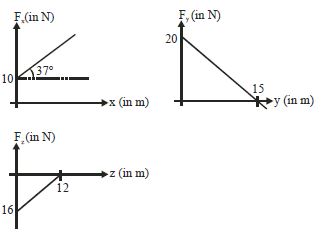
The components of a force acting on a particle are varying according to the graphs shown. To reach at point $B\, (8, 20, 0)$ from point $A\,(0, 5, 12)$ the particle moves on paths parallel to $x-$ axis then $y-$ axis and then $z-$ axis, then work done by this force is ............ $\mathrm{J}$
A block of metal weighing $2 \,kg$ is resting on a frictionless plane. It is struck by a jet releasing water at a rate of $1\, kg/sec$ and at a speed of $5\, m/sec$. The initial acceleration of the block will be .......... $m/\sec^2$
At $127^o C$ radiates energy is $2.7 \times 10^{-3} J/s$. At ....... $K$ temperature radiated energy is $4.32 \times 10^6 J/s$