Question
The human eye has an approximate angular resolution of $\phi=5.8\times10^{-4}$ rad and a typical photoprinter prints a minimum of 300dpi (dots per inch, 1inch = 2.54cm). At what minimal distance z should a printed page be held so that one does not see the individual dots.
Answer

We are given that, angular resolution of human eye $(\phi)=5.8\times10^{-4}$ red.
The printer prints 300 dots per inch.
The linear distance (l) between two dots can be calculated as $\frac{2.54}{300}\text{cm.}$
$=0.84\times10^{-2}\text{cm}$
Now, at a distance of z cm, this subtends an angle, $\phi=\frac{\text{l}}{\text{Z}}$
Substituting $(\phi)=5.8\times10^{-4}\text{ red and }=0.84\times10^{-2}\text{cm}$, we get
$\text{Z}=\frac{0.84\times10^{-2}\text{cm}}{5.8\times10^{-4}}=14.5\text{cm}.$

Need a full question paper?

Generate a complete, print-ready paper with questions like this in minutes — across 16+ boards, with answer keys.

Start Generating Free

Similar questions

In Young’s double slit experiment, the two slits 0.15 mm apart are illuminated by monochromatic light of wavelength 450 nm. The screen is 1.0 m away from the slits.
  1. Find the distance of the second (i) bright fringe, (ii) dark fringe from the central maximum.
  2. How will the fringe pattern change if the screen is moved away from the slits?
The work function of a metal is $2.5 x 10^{-19}J.$​​​​​​​
  1. Find the threshold frequency for photoelectric emission.
  2. If the metal is exposed to a light beam of frequency $6.0 x 10^{-14} Hz$, what will be the stopping potential?
n-identical cells, each of emf $\varepsilon,$ internal resistance r connected in series are charged by a dc source of emf $\varepsilon'$ using a resistance R.
  1. Draw the circuit arrangement.
  2. Deduce expressions for (a) the charging current and (b) the potential difference across the combination of cells.
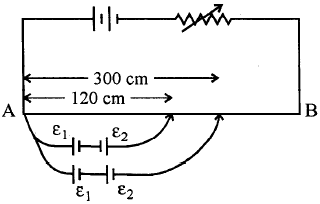
In the figure a long uniform potentiometer wireABis having a constant potential gradient along its length. The null points for the two primary cells of emfs $\varepsilon_{1}$ and $\varepsilon_{2}$
connected in the manner shown are obtained at a distance of 120 cm and 300 cm from the end A. Find (i) $\varepsilon_{1}$/$\varepsilon_{2}$and (ii) position of null point for the cell $\varepsilon_{1}$. How is the sensitivity of a potentiometer increased?
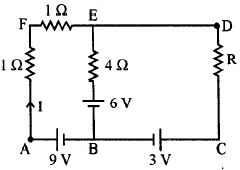
Using Kirchoffs rules determine the value of unknown resistance R in the circuit so that no current flows through 4 $\Omega$ resistance.Also find the potential difference between A and D.
A spy report about a suspected car reads as follows. "The car moved 2.00km towards east, made a perpendicular left turn, ran for 500m, made a perpendicular right turn, ran for 4.00km and stopped". Find the displacement of the car.
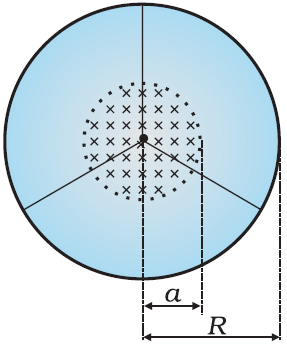
A line charge $\lambda$ per unit length is lodged uniformly onto the rim of a wheel of mass M and radius R. The wheel has light non-conducting spokes and is free to rotate without friction about its axis (Fig.). A uniform magnetic field extends over a circular region within the rim. It is given by,
$B = – B_0k (r ≤ a; a < R)$
= 0 (otherwise)
What is the angular velocity of the wheel after the field is suddenly switched off?
Calculate the change in internal energy of a gas kept in a rigid container when 100J of heat is supplied to it.
A 60kg man skating with a speed of 10m/s collides with a 40kg skater at rest and they cling to each other. Find the loss of kinetic energy during the collision.
Which wavelengths will be emitted by a sample of atomic hydrogen gas (in ground state) if electrons of energy 12.2eV collide with the atoms of the gas?
An electric bulb of volume 250cc was sealed during manufacturing at a pressure of $10^{-3}mm$ of mercury at $27^\circ C.$ Compute the number of air molecules contained in the bulb. Avogadro constant $= 6 \times 10^{23}mol^{-1}$, density of mercury $= 13600kg/ m^{-3} and g = 10ms^{-2}.$