Question
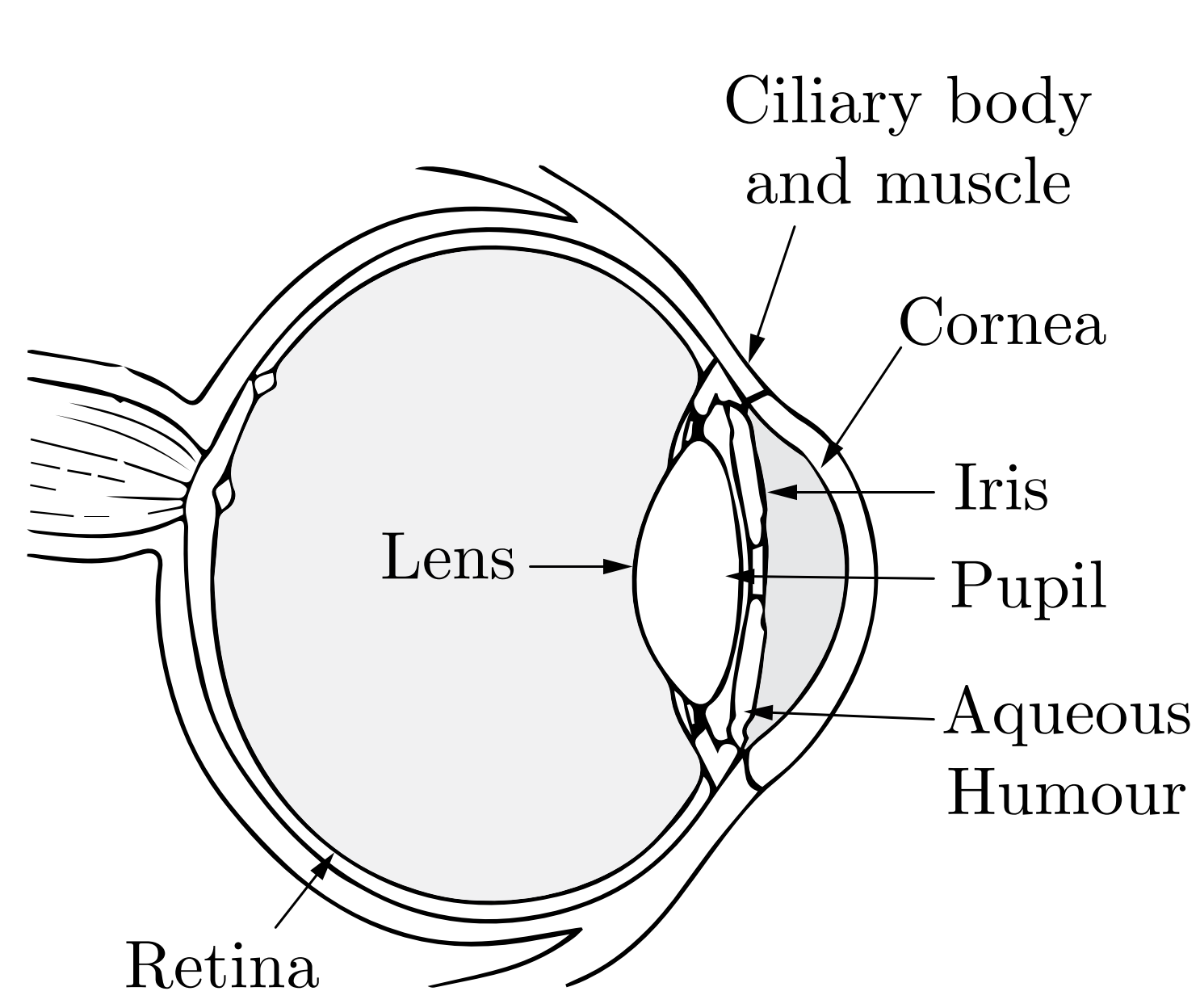
The human eye is like a camera. Its lens system forms an image on a light-sensitive screen called the retina. Light enters the eye through a thin membrane called the cornea. It forms the transparent bulge on the front surface of the eyeball as shown in the figure. The crystalline lens merely provides the finer adjustment of focal length required to focus objects at different distances on the retina. We find a structure called iris behind the cornea. Iris is a dark muscular diaphragm that controls the size of the pupil. The pupil regulates and controls the amount of light entering the eye.
There are mainly three common refractive defects of vision. These are (i) myopia or near-sightedness, (ii) hypermetropia or far-sightedness, and (iii) Presbyopia. These defects can be corrected by the use of suitable spherical lenses.
(i) What is the function of pupil in the human eye ?
(ii) What is the far point and near point of human eye with normal vision?
(iii) A student has difficulty reading the blackboard while sitting in the last row. What could be the defect the child is suffering from?
(iv) What is the function of iris in human eye ?
Answer

(i) The pupil regulates and controls the amount of light.
(ii) The far point is infinity and near point is about 25 $cm$ of the normal human eye.
(iii) The student is suffering from short-sightedness or myopia.
or
(iv) Iris is a dark muscular diaphragm that controls the size of the pupil.

Need a full question paper?

Generate a complete, print-ready paper with questions like this in minutes — across 16+ boards, with answer keys.

Start Generating Free

Similar questions

2. The Law of Octaves stated that – “when the elements are arranged in the order of increasing atomic masses, every eighth element had properties similar to that of the first”.
Why was the Law of Octaves not applicable to all elements?
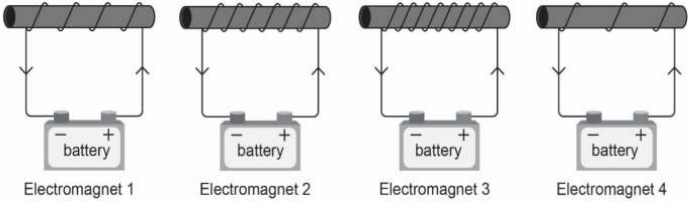
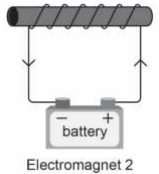
Sonia creates four electromagnets by placing iron bars in four different solenoids.
She brings a bunch of steel pins near each electromagnet.

Image
5. Which electromagnet will attract the maximum number of pins?
A. Electromagnet 1
B. Electromagnet 2
C. Electromagnet 3
D. Electromagnet 4
6. Which of these must Sonia keep the same for her activity?
Circle ‘Yes’ or ‘No’ for the correct response.

Should this be kept the same?

Yes or No

Thickness of the wires

Yes/No

Voltages of the batteries

Yes/No

Thickness of the iron bars

Yes/No

7. Label the north pole and south pole of the electromagnet in the diagram.

Image

8. Which of these devices works due to the magnetic effect of electric current?
A. LED bulb
B. Electric bell
C. Electric heater
D. Mobile charger

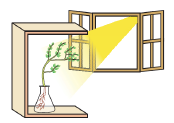
Fill a conical flask with water. Cover the neck of the flask with a wire mesh. keep two or three freshly germinated bean seeds on the wire mesh. Take a cardboard box which is open from one side. Keep the flask a wire mesh. Kin the box in such a manner that the open side of the box faces light coming from a window as shown in the given figure. After two or three days, you will notice that the shoots bend towards light and roots away from light. Now turn the flask so that the shoots are away from light and the roots towards the light. Leave it undisturbed in this condition for a few days. Plants show tropism in response to other stimuli as well. The roots of a plant always grow downwards while the shoots usually grow upwards and away from the earth. This upward and downward growth of shoots and roots, respectively, in response to the pull of earth or gravity, is obviously, geotropism.
Image

(a) What has represented by the given activities?
(b) Do old parts of the shoot and root change direction? Is there any difference in the direction of the new growth?
(c) What can we conclude from this activity?
OR
What is geotropism?
2. Which of these statements is true for the lines of a magnetic ield?
Circle ‘Yes’ or ‘No’ for the correct response.

Is the statement true?

Yes or No

Lines of a magnetic ield can sometimes cross each other.

Yes/No

Lines of a magnetic ield emerge from the north pole and meet at the south pole.

Yes/No

Lines of a magnetic ield can sometimes change direction.

Yes/No

Cellular respiration is a chemical process by which cells convert glucose to energy.
The equation given below shows the reaction for cellular respiration.

Image
3. In the above reaction, which substance is oxidised?
4. Carbon dioxide and water are the two new substances formed during cellular respiration. What are they known as?
A. Reactants
B. Mixtures
C. Catalysts
D. Products

The earth's crust is the major source of metals-seawater contains some soluble salts such as sodium chloride, magnesium chloride, etc. The elements or compounds, which occur naturally in the earth's crust are known as minerals. At some places, minerals contain a very high percentage of a particular metal and the metal can be profitably extracted from it. These minerals are called ores.
(i) Name the chief ore of mercury and zinc.
(ii) Write equations for the extraction of copper from its sulphide ore.
or
(ii) Define the process used to convert carbonate ores into metal oxide.
Mr. Rakesh was helping her daughter Aruna at home understanding about the basics of reflection of light. He found the simplest way to convey the role of curved mirrors using stainless steel teaspoon. Aruna got surprised to know that virtual image is that which can be seen but cannot be obtained on the screen. Mr. Rakesh then explained the formation of image using Ray diagrams.
(i) What do you mean by reflection of light?
(ii) The angle between incident ray and reflected ray is $60^{\circ}$. What is the value of angle of incidence?
(iii) A ray of light is incident on a plane mirror at an angle of $30^{\circ}$. what is the angle of reflection?
or
(iv) What happens to a light ray that is incident normally on a surface?

Read the following and answer any four questions from (i) to (v).
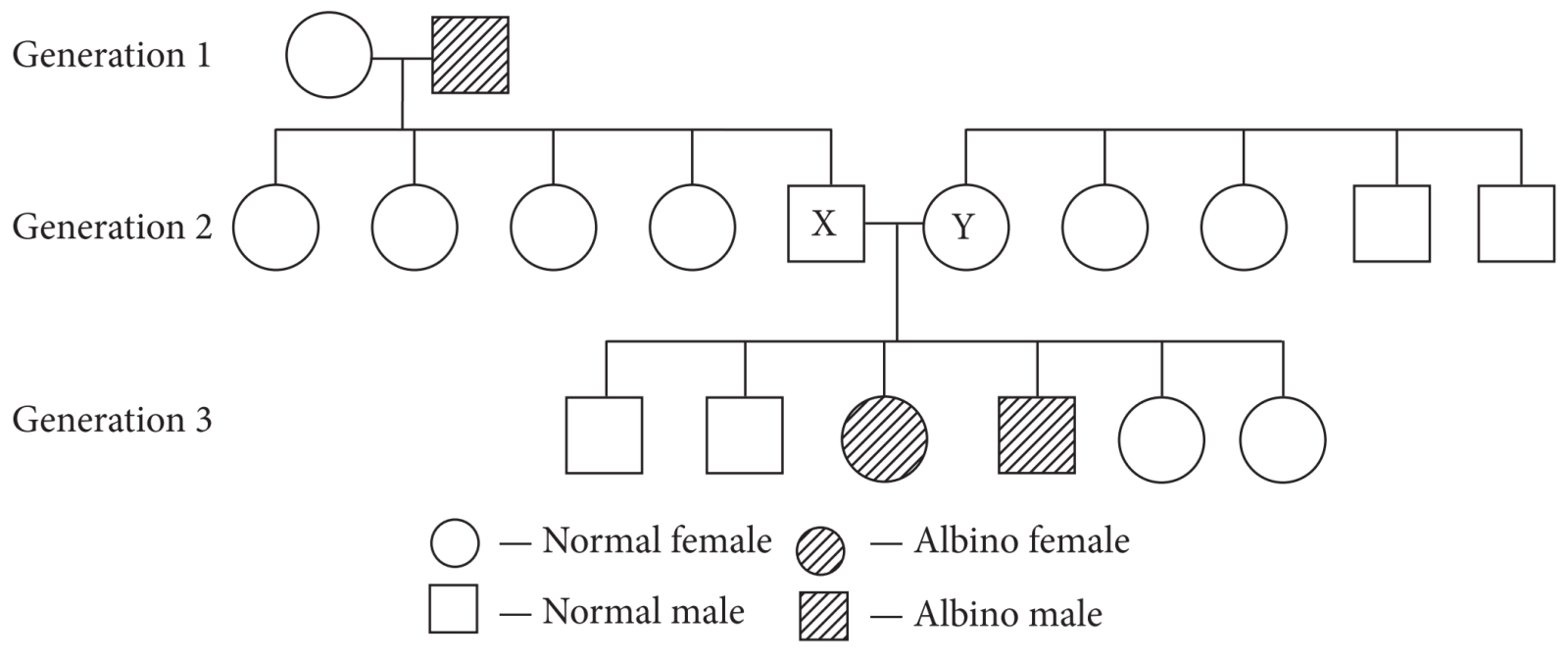
Refer to the schematic representation of the albinism that is an inherited condition caused by recessive allele (a). 'A' is the dominant allele for the normal condition. The inheritance of certain genetic traits for two or more generations is represented in a pedigree or family tree. Study the given pedigree chart and answer the following questions.
  1. Which of the following could be the genotypes of X and Y?
 
X
Y
(a)
AA
AA
(b)
AA
Aa
(c)
Aa
Aa
(d)
aa
aa
  1. Which of the following could be the genotype of generation - 1 male and female?
 
Male
Female
(a)
AA
aa
(b)
aa
AA
(c)
Aa
aa
(d)
AA
AA
  1. If X married an albino female, then what is the probability that their children would be albino?
  1. 0
  2. 0.125
  3. 0.25
  4. 0.5
  1. If Y married a normal homozygous male, then what is the probability that their children would be albino?
  1. 0
  2. 0.125
  3. 0.25
  4. 0.5
  1. Which of the following could be the genotype of offsprings produced by cross of X and Y?
  1. AA, Aa, aa
  2. aa, aa
  3. Aa, Aa
  4. AA, AA
Read the following and answer any four questions from (i) to (v).Reactions, in which one element takes place of another element in a compound, are known as displacement reactions. ln general, more reactive elements displaces a less reactive element from its compound. ln all single displacement reactions, only one element displaces another element from its compound. The single displacement reactions are, however, written as just displacement reactions. The displacement reaction between iron (III) oxide and powdered aluminum produces so much heat that iron metal obtained is in molten form.
  1. which of the metals from its salt solution displaces copper ?
  2. When zinc reacts with dilute sulfuric acid, which gas is evolved ?
  3. When dry hydrogen is passed over a heated oxide of metal X using the apparatus , what substance is obtained and it could be in which form ?
    OR
    a) Which reactions are called displacement reaction?
    b) When dilute hydrochloric acid is added to granulated zinc placed in a test tube, what result will be there after observation ?
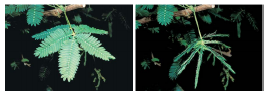
Animals have a nervous system for controlling and coordinating the activities of the body. But plants have neither a nervous system nor muscles. So, how do they respond to stimuli? When we touch the leaves of a chui- mui (the 'sensitive' or 'touch-me-not' plant of the Mimosa family), they begin to fold up and droop. When a seed germinates, the root goes down, the stem comes up into the air. What happens? Firstly, the leaves of the sensitive plant move very quickly in response to touch.
There is no growth involved in this movement. On the other hand, the directional movement of a seedling is caused by growth. If it is prevented from growing, it will not show any movement.
Image
(a) Write the types of movement.
(b) Give an example of a plant hormone that promotes growth.
(c) What is the function of the nervous system?
OR
How is the movement of leaves of the sensitive plant different from the movement of a shoot towards light?