MCQ
The hyper-metropia is a
  • A
    Short-side defect
  • Long- side defect
  • C
    Bad vision due to old age
  • D
    None of these

Answer

Correct option: B.
Long- side defect
b
( b)

Need a full question paper?

Generate a complete, print-ready paper with questions like this in minutes — across 16+ boards, with answer keys.

Start Generating Free

Similar questions

In an $LR$ -circuit, the inductive reactance is equal to the resistance $R$ of the circuit. An e.m.f. $E = {E_0}\cos (\omega t)$ applied to the circuit. The power consumed in the circuit is
$100$ cells each of $e.m.f.$ $5\, V$ and internal resistance $1\, ohm$ are to be arranged so as to produce maximum current in a $25\, ohms$ resistance. Each row is to contain equal number of cells. The number of rows should be
A metal rod of length $2\,m$ is rotating with an angular velocity of $100\, rad/sec$  in a plane perpendicular to a uniform magnetic field of $0.3 \,T$. The potential difference between the ends of the rod is.......$V$
In a potentiometer arrangement, a cell of emf $1.20\, V$ gives a balance point at $36\, cm$ length of wire. This cell is now replaced by another cell of emf $1.80\, V$. The difference in balancing length of potentiometer wire in above conditions will be $....cm$.
In a certain region of space, the potential is given by : $V = k[2x^2 - y^2 + z^2].$ The electric field at the point $(1, 1, 1) $ has magnitude =
$\Delta U + \Delta W = 0$ is valid for
A string of length $1\, m$ and mass $5\, g$ is fixed at both ends. The tension in the string is $8.0\, N$. The string is set into vibration using an external vibrator of frequency $100\, Hz$. The separation between successive nodes on the string is close to .... $cm$
The gravitational field in a region is given by $\overrightarrow g  = 5\,N/kg\hat i\, + \,12\,N/kg\hat j$. The change in the gravitational potential energy of a particle of mass $1\, kg$ when it is taken from the origin to a point $(7\, m, - 3\, m)$ is .......  $J$
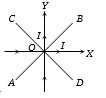
Two very thin metallic wires placed along $X$ and $Y$-axis carry equal currents as shown here. $AB$ and $CD$ are lines at $45^\circ $ with the axes with origin of axes at $O$. The magnetic field will be zero on the line
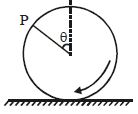
A wheel is rolling straight on ground without slipping. If the axis of the wheel has speed $v$, the instantenous velocity of a point $P$ on the rim, defined by angle $\theta $, relative to the ground will be