MCQ
The hyperfine lines in the spectrum is related to:
- AZeeman effect
- BStark effect
- CLande's splitting
- Dnuclear magnetic spin
Explanation:
In atomic physics, hyperfine structure is the different effects leading to small shifts and splitting in the energy levels of atoms, molecules and ions. The name is a reference to the fine structure which results from the interaction between the magnetic moments associated with electron spin and the electrons' orbital angular momentum. Hyperfine structure, with energy shifts is typically orders of magnitude smaller than the fine structure, results from the interactions of the nucleus (or nuclei, in molecules) with internally generated electric and magnetic fields.
Generate a complete, print-ready paper with questions like this in minutes — across 16+ boards, with answer keys.
The equivalent resistance and potential difference between A and B for the circuit is respectively

|
(a) 4 W, 8 V |
(b) 8 W, 4 V |
(c) 2 W, 2 V |
(d) 16 W, 8 V |
An electron jumps from the 4th orbit to the 2nd orbit of hydrogen atom. Given the Rydberg's constant  . The frequency in Hz of the emitted radiation will be
|
(a) |
(b) |
(c) |
(d) |
A current of two amperes is flowing through a cell of e.m.f. 5 volts and internal resistance 0.5 ohm from negative to positive electrode. If the potential of negative electrode is 10V, the potential of positive electrode will be
|
(a) 5 V |
(b) 14 V |
(c) 15 V |
(d) 16 V |
Choose the correct statement
|
(a) When we heat a semiconductor its resistance increases |
|
(b) When we heat a semiconductor its resistance decreases |
|
(c) When we cool a semiconductor to 0 K then it becomes super conductor |
|
(d) Resistance of a semiconductor is independent of temperature |
The magnetic potential at a point on the axial line of a bar magnet of dipole moment M is V. What is the magnetic potential due to a bar magnet of dipole moment  at the same point
| (a) 4V | (b) 2V |
(c) 
|
(d) 
|
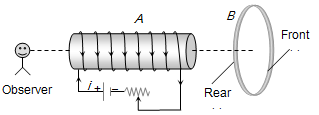
An aluminium ring B faces an electromagnet A. The current I through A can be altered
|
(a) Whether I increases or decreases, B will not experience any force |
|
(b) If I decrease, A will repel B |
|
(c) If I increases, A will attract B |
|
(d) If I increases, A will repel B |
The optical path of a monochromatic light is same if it goes through 4.0 cm of glass or 4.5 cm of water. If the refractive index of glass is 1.53, the refractive index of the water is
|
(a) 1.30 |
(b) 1.36 |
(c) 1.42 |
(d) 1.46 |


