Question
The image in a plane mirror is virtual and laterally inverted. What does this statement mean?

Answer

The image is virtual and laterally inverted means it cannot be obtained on a screen and is reversed sideways.

Need a full question paper?

Generate a complete, print-ready paper with questions like this in minutes — across 16+ boards, with answer keys.
Start Generating Free

Similar questions

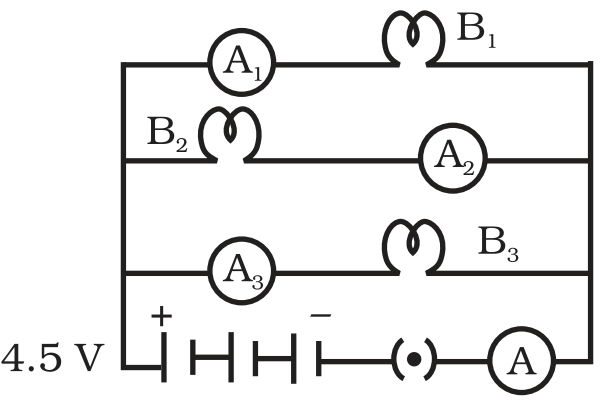
B1, B2 and B3 are three identical bulbs connected as shown in Figure. When all the three bulbs glow, a current of 3A is recorded by the ammeter A.

  1. What happens to the glow of the other two bulbs when the bulb B1 gets fused?
  2. What happens to the reading of A1, A2, A3 and A when the bulb B2 gets fused?
  3. How much power is dissipated in the circuit when all the three bulbs glow together?
At what distance from a concave mirror of focal length 10cm should an object be placed so that:
  1. Its real image is formed 20cm from the mirror?
  2. Its virtual image is formed 20cm from the mirror?
  1. A person cannot read newspaper placed nearer than 50 cm from his eyes. Name the defect of vision he is suffering from. Draw a ray diagram to illustrate this defect. List its two possible causes. Draw a ray diagram to show how this defect may be corrected using a lens of appropriate focal length.
  2. We see advertisements for eye donation on television or in newspapers. Write the importance of such advertisements.
  1. If the image formed by a mirror for all positions of the object placed in front of it is always diminished, erect and virtual, state the type of the mirror and also draw a ray diagram to justify your answer. Write one use such mirrors are put to and why.
  2. Define the radius of curvature of spherical mirrors. Find the nature and focal length of a spherical mirror whose radius of curvature is + 24 cm.
  1. Draw a ray diagram to show the formation of image of an object placed between infinity and the optical centre of a concave lens.
  2. A concave lens of focal length 15 cm forms an image10 cm from the lens. Calculate:
  1. The distance of the object from the lens.
  2. The magnification for the image formed.
  3. The nature of the image formed.
A nuclear reaction is represented by the equation:

$^{2}_{1}\text{H}+{^{2}_{1}\text{H}}\rightarrow{^{3}_{2}\text{He}}+\text{xc}+\text{E}$

  1. Name the process represented by this equation and describe what happens during this reaction.
  2. Identify the particle c and the number x of such particles produced in the reaction.
  3. What does E represent?
  4. State two conditions under which such a reaction takes place.
  5. What type of nuclear bomb is based on similar reactions?
What is Joule’s heating effect? How can it be demonstrated experimentally? List its four applications in daily life.
Differentiate between nuclear fission and nuclear fusion.
A student is unable to see clearly the words written on the blackboard placed at a distance of approximately 4 m from him. Name the defect of vision the boy is suffering from. Explain the method of correcting this defect. Draw ray diagram for the:
  1. Defect of vision and also.
  2. For its correction.
List the parts of the human eye that control the amount of light entering into it. Explain, how they perform this function?