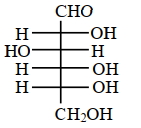
- ✓Can be oxidized to a dicarboxylic acid with $\mathrm{Br}_2$ water
- Bdespite the presence of - $\mathrm{CHO}$ does not give Schiff's test
- Chas $4$-asymmetric carbon atom
- Dwill coexist in equilibrium with $2$ other cyclic structure

statement $1$ is incorrect (monocarboxylic acid)
$(2)$ correct
$(3)$ $c.c.$ is $4$ (correct)
(Image)
Generate a complete, print-ready paper with questions like this in minutes — across 16+ boards, with answer keys.
$(I)$ $\left[\mathrm{Cr}\left(\mathrm{H}_{2} \mathrm{O}\right)_{6}\right] \mathrm{Br}_{2}$
$(II)$ $ \mathrm{Na}_{4}\left[\mathrm{Fe}(\mathrm{CN})_{6}\right]$
$(III)$ $\mathrm{Na}_{3}\left[\mathrm{Fe}\left(\mathrm{C}_{2} \mathrm{O}_{4}\right)_{3}\right]\left(\Delta_{0}>\mathrm{P}\right)$
$(IV)$ $\left(\mathrm{Et}_{4} \mathrm{N}\right)_{2}\left[\mathrm{CoCl}_{4}\right]$
$(I)$ $CH_3CH_2CH_2Cl$ $(II)$ $\begin{array}{*{20}{c}} {C{H_2} = CH\,CH\,C{H_3}} \\ {\,\,\,\,\,\,\,\,\,\,|} \\ {\,\,\,\,\,\,\,\,\,\,Cl} \end{array}$
$(III)$ $\begin{array}{*{20}{c}} {C{H_3}C{H_2}\,CH\,C{H_3}} \\ {\,\,\,|} \\ {\,\,\,\,Cl} \end{array}$