MCQ
The inherent property of all materials is:
  • A
    Diamagnetism.
  • B
    Paramagnetism.
  • C
    Ferromagnetism.
  • D
    Both a and b.

Answer

  1. Diamagnetism.

Explanation:

Diamagnetism (where orbital motion of electrons creates tiny atomic current loops, which produce magnetic fields) is a property of all materials and opposes applied magnetic fields, but is very weak.

Need a full question paper?

Generate a complete, print-ready paper with questions like this in minutes — across 16+ boards, with answer keys.

Start Generating Free

Similar questions

A body is suspended from a spring balance kept in a satellite. The reading of the balance is Wwhen the satellite goes in an orbit of radius R and is W2 when it goes in an orbit of radius 2R.
  1. W1 = W2
  2. W1 < W2
  3. W1 > W2
  4. W1 ≠ W2

In the given figure, battery E is balanced on 55 cm length of potentiometer wire but when a resistance of 10 W is connected in parallel with the battery then it balances on 50 cm length of the potentiometer wire then internal resistance r of the battery is
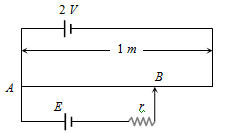
(a) 1 W

(b) 3 W

(c) 10 W

(d) 5 W

An electric dipole is placed at the centre of a sphere then:
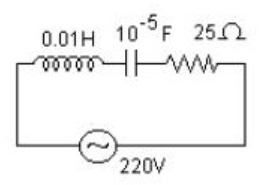
In the following circuit, the values of current flowing in the circuit at f = 0 and $\text{f}=\infty$ will respectively be.
Image
A capacitor is charged by a battery. The battery is removed, and another identical uncharged capacitor is connected in parallel. The total electrostatic energy of resulting system.
Which of the following phenomenon cannot take place with longitudinal waves (e.g., sound waves)?
Polar molecules has:
The uniform field between the plates of a parallel plate capacitor is E volt/meter. If the distance between the plates is $d ( m )$ and the area of each plate is $A \left( m ^2\right)$, then the total energy stored in it is :

The radius of circular path of an electron when subjected to a perpendicular magnetic field is

(a)  

(b)  

(c)  

(d)  

shows a capillary tube of radius r dipped into water. If the atmospheric pressure is P0 the pressure at point A is:

  1. $\text{P}_0$

  2. $\text{P}_0+ \frac{2\text{S}}{\text{r}}$

  3. $\text{P}_0- \frac{2\text{S}}{\text{r}}$

  4. $\text{P}_0- \frac{4\text{S}}{\text{r}}$