Question
The initial speed of a projectile fired from ground is $u$. At the highest point during its motion, the speed of projectile is $\frac{\sqrt{3}}{2} u$. The time of flight of the projectile is:

Answer

$u \cos \theta=\frac{\sqrt{3} u }{2} \Rightarrow \cos \theta=\frac{\sqrt{3}}{2}$

$\Rightarrow \theta=30^{\circ}$

$T =\frac{2 u \sin 30^{\circ}}{ g }=\frac{ u }{ g }$

Need a full question paper?

Generate a complete, print-ready paper with questions like this in minutes — across 16+ boards, with answer keys.
Start Generating Free

Similar questions

A metallic wire of length $L$ is fixed between two rigid supports. If the wire is cooled through a temperature difference $\Delta T$ ($Y$ = young’s modulus, $\rho$ = density, $\alpha$ = coefficient of linear expansion) then the frequency of transverse vibration is proportional to : 
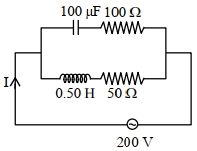
In the given circuit the ${AC}$ source has $\omega=100\, {rad} {s}^{-1}$. Considering the inductor and capacitor to be ideal, what will be the current $I$ flowing through the circuit? (in $A$)
A truck of mass $10,000\, kg$ moves up an inclined plane rising $1$ in $50$ with a speed of $36\, km/h$. Find the power of engine .................. $\mathrm{kW}$  $(g = 10\, m/s^2$)
A metal conductor of length $1\;m$ rotates vertically about one of its ends at angular velocity $5$ radians per second. If the horizontal component of earth's magnetic field is $0.2 \times {10^{ - 4}}\;T$, then the $e.m.f$. developed between the two ends of the conductor is
the magnetic induction at $O$ due to the whole length of the conductor is
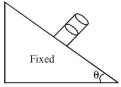
A cylindrical vessel filled with water is released on an inclined surface of angle $\theta$ as shown in figure.The friction coefficient of surface with vessel is $\mu( < \tan \theta)$.Then the contact angle made by the surface of water with the incline will be
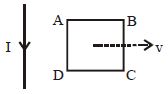
A metallic frame moves with constant velocity $v$ near a infinite length current carrying  wire. At any instant induced emf in sides $AD$ and $BC$ are $5\,V$ and  $2\,V$ respectively. If resistance of frame is $6\,\Omega$ then magnitude and direction of induced current in it 
Which of the following statements are true about acceleration due to gravity?
$(a)\, 'g'$ decreases in moving away from the centre if $r > R$
$(b)\, 'g'$ decreases in moving away from the centre if $r < R$
$(c)\, 'g'$ is zero at the centre of earth 
$(d)\, 'g'$ decreases if earth stops rotating on its axis
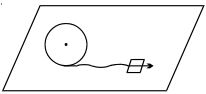
$A$ block of mass $m$ is attached to a pulley disc of equal mass $m$, radius $r$ by means of a slack string as shown. The pulley is hinged about its centre on a horizontal table and the block is projected with an initial velocity of $5\, m/s$. Its velocity when the string becomes taut will be
Inside a horizontally moving box, an experimenter finds that when an object is placed on a smooth horizontal table and is released, it moves with an acceleration of $10\,m / s ^2$. In this box if $1\,kg$ body is suspended with a light string, the tension in the string in equilibrium position (w.r.t. experimenter) will be$.........\,N$ (Take $g =10\,m / s ^2$ )