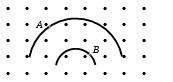
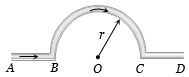
the magnetic induction at $O$ due to the whole length of the conductor is
Medium


Download our appand get started for free
Experience the future of education. Simply download our apps or reach out to us for more information. Let's shape the future of learning together!No signup needed.*
Similar Questions
- 1An $\alpha$-particle (mass $4 amu$ ) and a singly charged sulfur ion (mass $32 amu$ ) are initially at rest. They are accelerated through a potential $V$ and then allowed to pass into a region of uniform magnetic field which is normal to the velocities of the particles. Within this region, the $\alpha$-particle and the sulfur ion move in circular orbits of radii $r_\alpha$ and $r_5$, respectively. The ratio $\left(r_s / r_\alpha\right)$ is. . . . .$(4)$View Solution
- 2A galvanometer has a resistance of $25\, ohm$ and a maximum of $0.01\, A$ current can be passed through it. In order to change it into an ammeter of range $10\, A$, the shunt resistance required isView Solution
- 3A proton moving with a velocity, $2.5 \times {10^7}\,m/s$, enters a magnetic field of intensity $2.5\,T$ making an angle ${30^o}$ with the magnetic field. The force on the proton isView Solution
- 4A solenoid of $1.5$ $metre$ length and $4.0\, cm$ diameter posses $10$ $turn$ per $cm$. A current of $5$ $ampere$ is flowing through it. The magnetic induction at axis inside the solenoid isView Solution
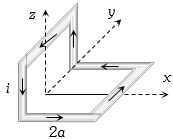
- 5A non-planar loop of conducting wire carrying a current $I$ is placed as shown in the figure. Each of the straight sections of the loop is of length $2a$. The magnetic field due to this loop at the point $P$ $(a,0,a)$ points in the directionView Solution
- 6A particle is moving with velocity $\overrightarrow{ v }=\hat{ i }+3 \hat{ j }$ and it produces an electric field at a point given by $\overrightarrow{ E }=2 \hat{ k }$. It will produce magnetic field at that point equal to (all quantities are in SI units)View Solution
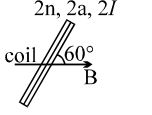
- 7A rectangular coil $PQ$ has $2n$ turns, an area $2a$ and carries a current $2I,$ (refer figure). The plane of the coil is at $60^o$ to a horizontal uniform magnetic field of flux density $B.$ The torque on the coil due to magnetic force isView Solution
- 8The magnetic field on the axis of a circular loop of radius $100\,cm$ carrying current $I=\sqrt{2}\,A$, at point $1\,m$ away from the centre of the loop is given byView Solution
- 9View SolutionA strong magnetic field is applied on a stationary electron, then
- 10Two particles $A$ and $B$ of masses ${m_A}$ and ${m_B}$ respectively and having the same charge are moving in a plane. A uniform magnetic field exists perpendicular to this plane. The speeds of the particles are ${v_A}$ and ${v_B}$ respectively, and the trajectories are as shown in the figure. ThenView Solution