Question
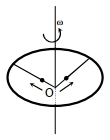
The instantaneous angular position of a point on a rotating wheel is given by the  equation $\theta (t) = 2t^3-6t^2$. The torque on the wheel becomes zero at $t=$ ....... $\sec.$

Answer

Given $: \theta(t)=2 t^{3}-6 t^{2}$

$\frac{\mathrm{d} \theta}{\mathrm{dt}}=6 \mathrm{t}^{2}-12 \mathrm{t}$

$\frac{\mathrm{d}^{2} \theta}{\mathrm{dt}^{2}}=12 \mathrm{t}-12$

Angular acceleration, $\alpha=\frac{\mathrm{d}^{2} \theta}{\mathrm{dt}^{2}}=12 \mathrm{t}-12$

When angular acceleration $(\alpha$ ) is zero, then the torque on the wheel becomes zero

$(\because \tau=\mathrm{I} \alpha)$

$\Rightarrow 12 t-12=0$ or $t=1\,s$

Need a full question paper?

Generate a complete, print-ready paper with questions like this in minutes — across 16+ boards, with answer keys.
Start Generating Free

Similar questions

A stone is shot straight upward with a speed of $20\, m/sec$ from a tower $200\, m$ high. The speed with which it strikes the ground is approximately........$m/sec$
The dimensions of permittivity ${\varepsilon _0}$ are
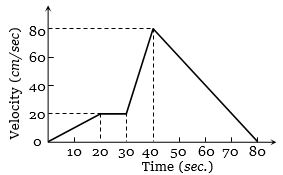
The $v - t$ graph of a moving object is given in figure. The maximum acceleration is...........$\mathrm{cm/sec}^{2}$
The approximate wavelength of a photon of energy $2.48 \,eV$ is ............ $\mathring A$
A magnet of magnetic moment $M$ is situated with its axis along the direction of a magnetic field of strength $B.$  The work done in rotating it by an angle of $180°$  will be
The temperature of a gas is doubled $(i)$ on absolute scale $(ii)$ on centigrade scale. The increase in root mean square velocity of gas will be
When the convergent nature of a convex lens will be less as compared with air
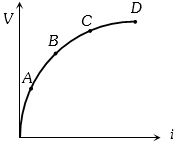
Variation of current passing through a conductor as the voltage applied across its ends as varied is shown in the adjoining diagram. If the resistance $(R)$ is determined at the points $A$, $B$, $C$ and $D$, we will find that
A ring of mass $M$ and radius $R$ is rotating with angular speed $\omega$ about a fixed vertical axis passing through its centre $O$ with two point masses each of mass $\frac{ M }{8}$ at rest at $O$. These masses can move radially outwards along two massless rods fixed on the ring as shown in the figure. At some instant the angular speed of the system is $\frac{8}{9} \omega$ and one of the masses is at a distance of $\frac{3}{5} R$ from $O$. At this instant the distance of the other mass from $O$ is
Due to the earth's magnetic field, charged cosmic ray particles