MCQ
The instantaneous angular position of a point on a rotating wheel is given by the equation $\theta $$(t)=2t^3-6t^2 $ The torque on the wheel becomes zero at $t=$ ...... $\sec$
  • $1$
  • B
    $0.5$
  • C
    $0.25$
  • D
    $2$

Answer

Correct option: A.
$1$
a
Given : $\theta \left( t \right) = 2{t^3} - 6{t^2}$

$\therefore \,\frac{{d\theta }}{{dt}} = 6{t^2} - 12t \Rightarrow \frac{{{d^2}\theta }}{{d{t^2}}} = 12t - 12$

Angular acceleration, $\alpha  = \frac{{{d^2}\theta }}{{d{t^2}}} = 12t - 12$

When angular acceleration $(\alpha )$ is zero, then the torque on the wheel becomes zero $\left( {\,\tau  = I\alpha } \right)$

$ \Rightarrow \,12t - 12 = 0\,\,or\,t = 1\,s$

Need a full question paper?

Generate a complete, print-ready paper with questions like this in minutes — across 16+ boards, with answer keys.
Start Generating Free

Similar questions

When two tuning forks (fork $1$ and fork $2$) are sounded simultaneously, $4$ beats per second are heard. Now, some tape is attached on the prong of the fork $2$. When the tuning forks are sounded again, $6$ beats per second are heard. If the frequency of fork $1$ is $200\, Hz$, then what was the original frequency of fork $2$? .... $Hz$
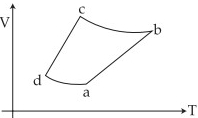
An ideal gas goes through a reversible cycle $a\to b\to c\to d$ has the $V - T$ diagram shown below. Process $d\to a$ and $b\to c$ are adiabatic....  The corresponding $P - V$ diagram for the process is (all figures are schematic and not drawn to scale)
If black wire of platinum is heated, then its colour first appear red, then yellow and finally white. It can be understood on the basis of
A mass of $50\,g$ of water in a closed vessel, with surroundings at a constant temperature takes $2\, minutes$ to cool from $30\,^oC$ to $25\,^oC$. A mass of $100\,g$ of another liquid in an identical vessel with identical surroundings takes the same time to cool from $30\,^oC$ to $25\,^o C$. The specific heat of the liquid is .......... $kcal/kg$ (The water equivalent of the vessel is $30\,g$.)
A second harmonic has to be generated in a string of length $l$ stretched between two rigid supports. The point where the string has to be plucked and touched are
In an inelastic collision:
Diatomic molecules like hydrogen have energies due to both translational as well as rotational motion. From the equation in kinetic theory $\text{PV} = \frac{2}{3}$ E,E is:
  1. The total energy per unit volume.
  2. Only the translational part of energy because rotational energy is very small compared to the translational energy.
  3. Only the translational part of the energy because during collisions with the wall pressure relates to change in linear momentum.
  4. The translational part of the energy because rotational energies of molecules can be of either sign and its average over all the molecules is zero.
A block of mass $5\,kg$ is placed at rest on a table of rough surface. Now, if a force of $30\,N$ is applied in the direction parallel to surface of the table, the block slides through a distance of $50\,m$ in an interval of time $10\,s$. Coefficient of kinetic friction is (given, $g =10\,ms ^{-2}$)
Two ions have equal masses but one is singly-ionised and the other is doubly-ionised. They are projected from the same place in a uniform magnetic field with the same velocity perpendicular to the field.
  1. Both ions will move along circles of equal radii.
  2. The circle described by the singly-ionised charge will have a radius that is. double that of the other circle.
  3. The two circles do not touch each other.
  4. The two circles touch each other.
A moving particle of mass $m,$ makes a head on elastic collision with another particle of mass $2\,m,$ which is initially at rest. The percentage loss in energy of the colliding particle on collision, is close to .................. $\%$