Question
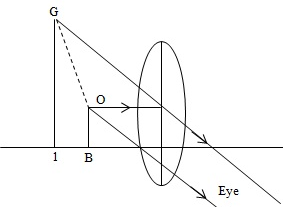
The instrument that is based on the principle that when an object is placed between first principal focus and the optic centre of convex lens, an upright, virtual and enlarged image on the same side of the object is formed, is:
Answer

  1. Simple microscope
Explanation:
In astronomical telescope 2 convex lens called eyepiece and objective lens are used and object is placed before eyepiece lens, such that final image inverted, a camera and eye also form inverted image on the screen.
Whereas simple microscope gives an erect, virtual and enlarged image of the object placed between first principal focus and the optic nerve of the convex lens.
In a projector, the image formed is real, inverted magnified on the other side of the lens. This inverted image is again inverted by the film.

Need a full question paper?

Generate a complete, print-ready paper with questions like this in minutes — across 16+ boards, with answer keys.
Start Generating Free

Similar questions

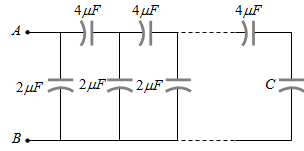
A finite ladder is constructed by connecting several sections of $2\ \mu F,4 \ \mu F$ capacitor combinations as shown in the figure. It is terminated by a capacitor of capacitance $C$. What value should be chosen for $C$ such that the equivalent capacitance of the ladder between the points $A$ and $B$ becomes independent of the number of sections in between
Which of the following statement is not correct about two parallel conductors carrying equal currents in the same direction?
During a nuclear fusion reaction:
What is the value of capacitance of a capacitor if it has a charge of 9C and voltage of 5V?
Whenever light travels from denser medium to a rarer medium:
The average binding energy per nucleon in the nucleus of an atom is approximately(a) 8 eV(b) 8 KeV(c) 8 MeV(d) 8 J
       
Assertion  :  Two P-N junction diodes placed back to back, will work as a NPN transistor.
Reason     : The P-region of two PN junction diodes back to back will form the base of NPN transistor.(a) If both assertion and reason are true and the reason is the correct explanation of the assertion.(b) If both assertion and reason are true but reason is not the correct explanation of the assertion.(c) If assertion is true but reason is false.(d) If the assertion and reason both are false.


Absolute refractive indices of glass and water are $\frac{3}{2}$ and $\frac{4}{3}$. The ratio of velocity of light in glass and water will be
A conducting disc of radius r spins about its axis with an angular velocity ω. There is a uniform magnetic field of magnetude B perpendicular to the plane of the disc. C is the centre of the ring.
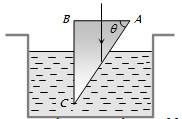
A glass prism $(\mu = 1.5)$ is dipped in water $(\mu = 4/3)$ as shown in figure. A light ray is incident normally on the surface $AB.$ It reaches the surface $BC$ after totally reflected, if