MCQ

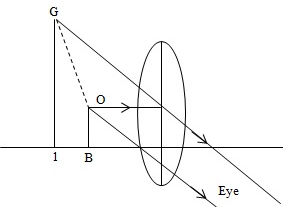
The instrument that is based on the principle that when an object is placed between first principal focus and the optic centre of convex lens, an upright, virtual and enlarged image on the same side of the object is formed, is:

  • A
    Telescope
  • B
    Projector
  • C
    Camera
  • D
    Simple microscope

Answer

  1. Simple microscope

Explanation:

In astronomical telescope 2 convex lens called eyepiece and objective lens are used and object is placed before eyepiece lens, such that final image inverted, a camera and eye also form inverted image on the screen.

Whereas simple microscope gives an erect, virtual and enlarged image of the object placed between first principal focus and the optic nerve of the convex lens.

In a projector, the image formed is real, inverted magnified on the other side of the lens. This inverted image is again inverted by the film.

Need a full question paper?

Generate a complete, print-ready paper with questions like this in minutes — across 16+ boards, with answer keys.

Start Generating Free

Similar questions

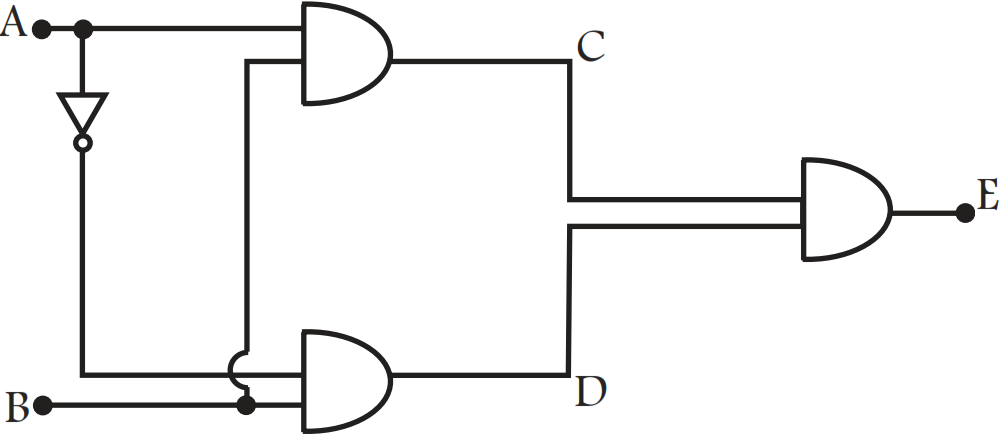
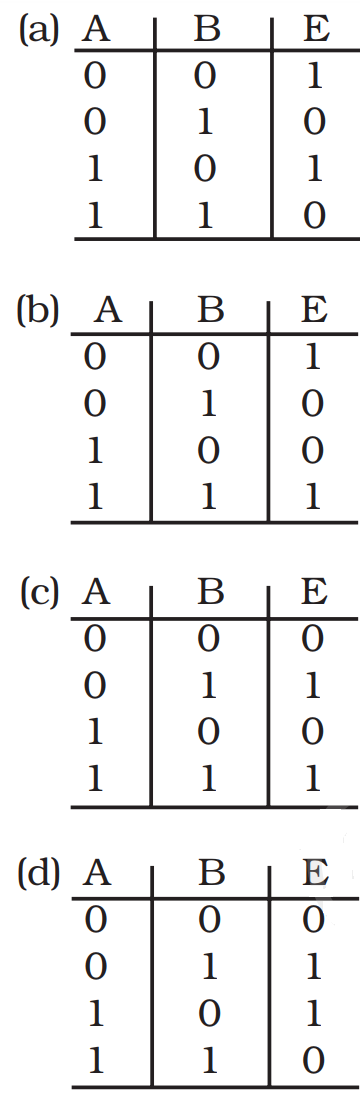
Truth table for the given circuit (Fig.) is:

The light rays having photons of energy 1.8 eV are falling on a metal surface having a work function 1.2 eV. What is the stopping potential to be applied to stop the emitting electrons

(a) 3 eV

(b) 1.2 eV

(c) 0.6 eV  

(d) 1.4 eV

Which one of the following is the practical unit of power?

Which of the following isotopes is used for the treatment of cancer

(a)  

(b)  

(c)    

(d)  

The rate of disintegration was observed to be  disintegrations per sec when its half life period is 1445 years. The original number of particles are

(a) 8.9  

(b) 6.6  

(c) 1.4  

(d) 1.2  

The work function of a metal is

(a) The energy for the electron to enter into the metal

(b) The energy for producing X-ray

(c) The energy for the electron to come out from metal surface

(d) None of these

Sum of the two binary numbers  and    is

(a)  

(b)  

(c)  

(d)  

The current flowing in a copper voltameter is 3.2 A. The number of copper ions ( deposited at the cathode per minute is

(a) 0.5  

(b) 1.5  

(c) 3  

(d) 6  

Water is flowing in streamliries motion through a tube with its axis horizontal Consider two points A and B in the tube at the same horizontal level:
  1. The pressures at A and B are equal for any shape of the tube.
  2. The pressures are never equal.
  3. The pressures are equal if the tube has a uniform cross section.
  4. The pressures may be equal even if the tube has a nonuniform cross section.
The nuclei having same number of protons but different number of neutrons are called _________.