- A$\frac{{{I_0}}}{4}$
- B$\;\frac{3}{4}{I_0}$
- ✓$\;\frac{{{I_0}}}{2}$
- D$\;{I_0}$
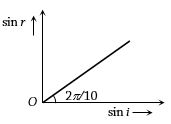
Resultant Intensity at $y=\frac{d}{2}, I_{y}=?$
The path difference between two waves at $y=\frac{d}{2}$
$\Delta x = d\tan \theta = $ $d \times \frac{y}{D} = $ $\frac{{d \times \frac{d}{2}}}{{10d}} = $ $\frac{d}{{20}} = \frac{{5\lambda }}{{20}} = \frac{\lambda }{4}$
Corresponding phase difference, $\phi=\frac{2 \pi}{\lambda} \Delta x=\frac{\pi}{2}$
Now, maximum intensity in Young's double slit experiment,
${I_{\max }} = {I_1} + {I_2} + 2{I_1}{I_2}$
${I_0} = 4I$ $(\because \,\,{I_1}\, = \,{I_2}\, = \,I)$
$\therefore I=\frac{I_{0}}{4}$
Required intensity,
${I_y} = {I_1} + {I_2} + 2{I_1}{I_2}\cos \frac{\pi }{2}$ $ = 2I = \frac{{{I_0}}}{2}$
Generate a complete, print-ready paper with questions like this in minutes — across 16+ boards, with answer keys.


Choose the correct statement related to the potential of the shell in absence of $q_B$