The intensity of sound after passing through a slab decreases by $30\%$. On passing through two such slabs, the intensity will decrease by ..... $\%$
Medium
Download our app for free and get started
So, Intensity will decrease by
$=\mathrm{I}_{0}-0.49 \mathrm{I}_{0}=0.51 \mathrm{I}_{0}=51 \%$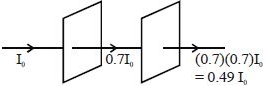

Download our appand get started for free
Experience the future of education. Simply download our apps or reach out to us for more information. Let's shape the future of learning together!No signup needed.*
Similar Questions
- 1View SolutionThe Doppler effect is applicable for
- 2A sound source emits sound waves in a uniform medium. If energy density is $E$ and maximum speed of the particles of the medium is ${v_{\max }}.$The plot between $E$ and ${v_{\max }}$ is best represented byView Solution
- 3The displacement y of a particle in a medium can be expressed as: $y = {10^{ - 6}}\sin (100t + 20x + \pi /4)m,$ where $t$ is in second and $x$ in meter. The speed of wave is ... $m/s$View Solution
- 4A wave travelling along the $x-$axis is described by the equation $y\left( {x,t} \right) = 0.005cos\left( {\alpha x - \beta t} \right)$ If the wavelength and the time period of the wave are $0.08\ m$ and $2.0\ s$, respectively, then $\alpha$ and $\beta$ in appropriate units areView Solution
- 5Two vibrating tuning forks produce progressive waves given by ${y_1} = 4\,\sin \,\left( {500\pi t} \right)$ and ${y_2} = 2\,\sin \,\left( {506\pi t} \right)$. These tuning forks are held near the ear of a person. The person will hear $\alpha \, beats/s$ with intensity ratio between maxima and minima equal to $\beta $. Find the value of $\beta - \alpha $View Solution
- 6The vibrations of a string of length $60\, cm$ fixed at both the ends are represented by the equation $y = 2\,\sin \,\left( {\frac{{4\pi x}}{{15}}} \right)\,\cos \,\left( {96\pi t} \right)$ where $x$ and $y$ are in $cm$. The maximum number of loops that can be formed in it isView Solution
- 7A transverse harmonic wave on a string is described by $y = 3 \sin \,(36t + 0.018x + \frac{\pi}{4})$ where $x$ and $y$ are in $cm$ and $t$ in $s$. The least distance between two sucessive crests in the wave is .... $m$View Solution
- 8In a medium sound travels $2\, km$ in $3\, sec$ and in air, it travels $3 \,km$ in $10\, sec$. The ratio of the wavelengths of sound in the two media isView Solution
- 9The equation of displacement of two waves are given as ${y_1} = 10\sin \left( {3\pi t + \frac{\pi }{3}} \right)$; ${y_2} = 5(\sin 3\pi t + \sqrt 3 \cos 3\pi t)$. Then what is the ratio of their amplitudesView Solution
- 10The first overtone frequency of an open organ pipe is equal to the fundamental frequency of a closed organ pipe. If the length of the closed organ pipe is $20 \,cm$. The length of the open organ pipe is........$cm$.View Solution