MCQ
The internal energy of an ideal gas depends on:
  • A
    Pressure.
  • B
    Volume.
  • C
    Temperature.
  • D
    Size of the molecule.

Answer

  1. Temperature.

Need a full question paper?

Generate a complete, print-ready paper with questions like this in minutes — across 16+ boards, with answer keys.

Start Generating Free

Similar questions

The radii of circular orbits of two satellites $A$ and $B$ of the earth, are $4R$ and $R,$ respectively. If the speed of satellite $A$ is $3\, V,$ then the speed of satellite $B$ will be ...... $V$
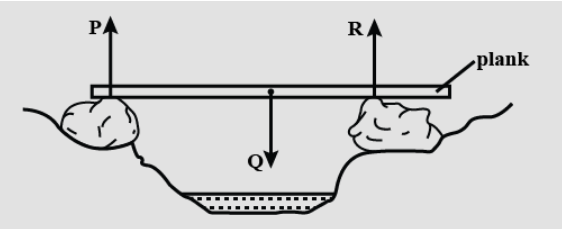
A wooden plank rests in equilibrium on two rocks on opposite sides of a narrow stream. Three forces P, Q and R act on the plank. How are the sizes of the forces related?

$100$  coplanner forces each equal to  $10\,\,N$  act on a body. Each force makes angle $\pi /50$ with the preceding force. What is the resultant of the forces.......... $N$
A travelling wave pulse is given by $y=\frac{4}{3 x^2+48 t^2+24 x t+2}$ where $x$ and $y$ are in metre and $t$ is in second. The velocity of wave is ........... $m / s$
Consider two containers $A$ and $B$ containing monoatomic gases at the same Pressure $(P)$, Volume $(V)$ and Temperature $(T)$. The gas in $A$ is compressed isothermally to $\frac{1}{8}$ of its original volume while the gas $B$ is compressed adiabatically to $\frac{1}{8}$ of its original volume. The ratio of final pressure of gas in $B$ to that of gas in $A$ is ...........
A uniform thin rod of length $l$ is suspended from one of its ends and is rotated at $f$ rotations per second. The rotational kinetic energy of the rod will be
For free expansion of the gas which of the following is true
A particle gets displaced by $\Delta \,\vec r = \,(2\hat i + 3\hat j + 4\hat k)$ $m$ under the action of a force $\vec F = \,(7\hat i + 4\hat j + 3\hat k)$ The change in its kinetic energy is ............... $\mathrm{J}$
As observed from earth, the sun appears to move in an approximate circular orbit. For the motion of another planet like mercury as observed from earth, this would.
  1. Be similarly true.
  2. Not be true because the force between earth and mercury is not inverse square law.
  3. Not be true because the major gravitational force on mercury is due to sun.
  4. Not be true because mercury is influenced by forces other than gravitational forces.
A liquid will not wet the surface of a solid, if the angle of contact is: