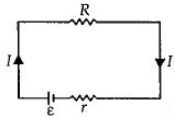
The internal resistance of a $2.1\, V$ cell which gives a current of $0.2\, A$ through a resistance of $10\,\Omega$ is ............. $\Omega$
AIPMT 2013, Medium


Download our appand get started for free
Experience the future of education. Simply download our apps or reach out to us for more information. Let's shape the future of learning together!No signup needed.*
Similar Questions
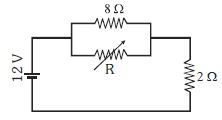
- 1The value of the resistance $R$ in figure is adjusted such that power dissipated in the $2\,\Omega $ resistor is maximum. Then the power dissipated in the $2\,\Omega $ will be ................ $W$View Solution
- 2A potentiometer consists of a wire of length $4\, m$ and resistance $10\,\Omega $. It is connected to a cell of $e.m.f.$ $2\, V$. The potential difference per unit length of the wire will be ............. $V/m$View Solution
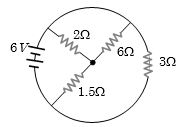
- 3The total current supplied to the circuit by the battery is ............. $A$View Solution
- 4The effective resistance of two resistors in parallel is $\frac{{12}}{7}\,\Omega $. If one of the resistors is disconnected the resistance becomes $4$ $\Omega$. The resistance of the other resistor is.............. $\Omega$View Solution
- 5A resistor ${R_1}$ dissipates the power $P$ when connected to a certain generator. If the resistor ${R_2}$ is put in series with ${R_1}$, the power dissipated by ${R_1}$View Solution
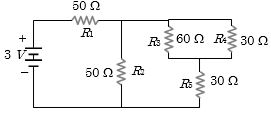
- 6In circuit shown below, the resistances are given in $ohms$ and the battery is assumed ideal with emf equal to $3\, volt$. The voltage across the resistance $R_4$ is ................. $V$View Solution
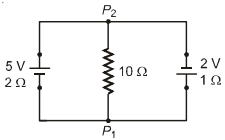
- 7A $5\ V$ battery with internal resistance $2\,\Omega$ and a $2\,V$ battery with internal resistance ln are connected to a $10\,\Omega$ resistor as shown in the figure.View Solution
- 8The potential difference in open circuit for a cell is $2.2\, volts$. When a $4\, ohm$ resistor is connected between its two electrodes the potential difference becomes $2\, volts$. The internal resistance of the cell will be .............. $ohm$View Solution
- 9On giving $220\,V$ to a resistor the power dissipated is $40\,W$ then value of resistance is ............... $\Omega$View Solution
- 10In the given figure, the equivalent resistance between the points $A$ and $B$ is ............ $\Omega$View Solution