A potentiometer consists of a wire of length $4\, m$ and resistance $10\,\Omega $. It is connected to a cell of $e.m.f.$ $2\, V$. The potential difference per unit length of the wire will be ............. $V/m$
AIPMT 1999, Easy


Download our appand get started for free
Experience the future of education. Simply download our apps or reach out to us for more information. Let's shape the future of learning together!No signup needed.*
Similar Questions
- 1A fuse wire with radius $1\, mm$ blows at $1.5\, amp$. The radius of the fuse wire of the same material to blow at $3\,A$ will beView Solution
- 2Power dissipated across the $8\,\Omega $ resistor in the circuit shown here is $2\, watt$. The power dissipated in watt units across the $3\,\Omega $ resistor isView Solution
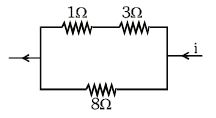
- 3Find the power of the circuit ............ $W$View Solution
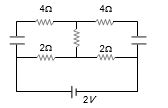
- 4The value of internal resistance of an ideal cell is $\Omega$View Solution
- 5A copper wire of length $1\, m$ and radius $1\, mm$ is joined in series with an iron wire of length $2\, m$ and radius $3\, mm$ and a current is passed through the wires. The ratio of the current density in the copper and iron wires isView Solution
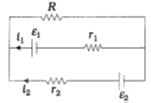
- 6View SolutionConsider the circuit shown in the figure
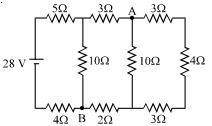
- 7In the circuit shown below, the cell has an $e.m.f.$ of $10\,V$ and internal resistance of $1\, ohm$. The other resistances are shown in the figure. The potential difference ${V_A} - {V_B}$ is ................ $V$View Solution
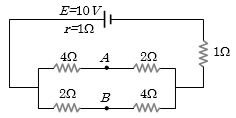
- 8Two electric bulbs rated ${P_1}\,watt$ $V\, volts$ and ${P_2}\, watt$ $V\, volts$ are connected in parallel and $V\, volts$ are applied to it. The total power will beView Solution
- 9A current of $2\, A$ flows in a system of conductors as shown. The potential difference $(V_A -V_B)$ will be ................ $\mathrm{V}$View Solution
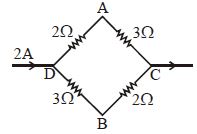
- 10View SolutionSee the electrical circuit shown in this figure. Which of the following equations is a correct equation for it ?